

Written By: Michael Vale
Reviewed By: Bridgette Austin, Esq., EA, Co-Founder and Tax Attorney
Last Reviewed: August 11, 2026
A CP14 is the first balance-due notice the IRS sends, and it starts the clock on collection. If one just arrived, you are not in serious trouble yet, but you have a short window to act. The notice asks you to pay within 21 days, or within 10 business days if you owe $100,000 or more. You have four real choices: pay in full, set up a payment plan, ask for penalty relief, or dispute the amount if it is wrong. The right move depends on whether the balance is actually correct, so the first step is to confirm it, not to pay on reflex and not to panic.
Quick answer: A CP14 notice means IRS records show you owe at least $5 in unpaid tax, penalties, or interest for one tax year. It requests payment within 21 days and marks the start of the IRS collection process. Confirm the balance against your account transcript, then pay, set up a plan, request abatement, or dispute it before the deadline.

What is an IRS CP14 notice?
A CP14 notice is the first balance-due letter the IRS sends when its records show you owe $5 or more in tax, penalties, or interest for a specific year. It states the total due, sets a 21-day payment deadline, and officially begins the IRS collection process for that balance.
It is an automated notice, generated when a tax year closes with money still owed and no math error on the account. The letter breaks the balance into the tax owed, the penalties added, and the interest accrued, then prints a total and a due date. The IRS sends more than 8 million CP14 notices in a typical year, which makes it the most common letter the agency mails. You can read the agency’s own summary on the IRS CP14 page.
Why the IRS sent you a CP14
In most cases, you got a CP14 because a tax year closed with an unpaid balance. The exact trigger is usually one of five.
The most common is that you filed your return and either could not pay the balance or paid only part of it. The unpaid portion, plus interest and a failure-to-pay penalty, now sits on your account. A close second is the extension trap: you filed Form 4868 on time but paid the balance after the April deadline, so a late-payment penalty and interest attached even though the return itself was on time. Other triggers include an estimated-tax shortfall, common for self-employed people and investors who owe more than $1,000; an IRS adjustment from a math-error correction or an unanswered CP2000 underreporter notice; and a simple processing lag on a payment you already made.
Important: An extension to file is not an extension to pay. If you filed Form 4868 and paid after the April deadline, that late payment can show up on a CP14 with a penalty and interest attached, even though your return was filed on time.

What to do when you get a CP14 in 2026
The right first move is to confirm the balance is real, then match the response to the numbers. Work through four steps in order: confirm, classify, choose, and document.
| Step | What you do | Why it matters | When |
|---|---|---|---|
| 1. Confirm | Read the notice, then log in at IRS.gov and pull your account transcript for that year | The transcript is the IRS’s authoritative record of every payment, penalty, and assessment | Within 2 to 3 days |
| 2. Classify | Compare the transcript to your own records and decide: correct, partly correct, or wrong | This is the only way to know whether your move is pay, dispute, or wait | First week |
| 3. Choose | Pick a path: pay in full, set up a payment plan, request penalty relief, or dispute | The numbers set the path, not what you wish were true | Before the due date |
| 4. Document | Save every confirmation number, transcript, and piece of correspondence | If a later notice goes out in error, the paper trail is what fixes it | Ongoing |
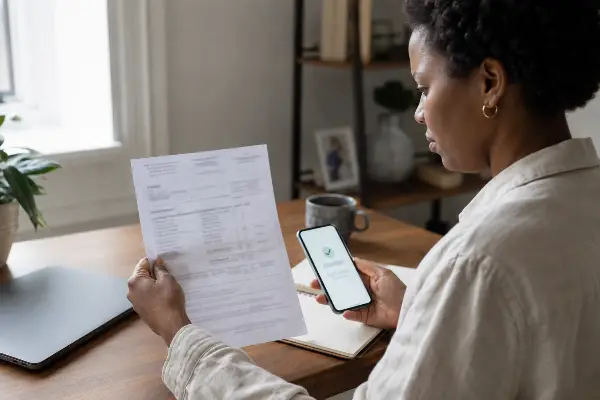
“I already paid. Why did you send a CP14?”
If you already paid and still got a CP14, the cause is almost always a timing gap between the date your payment posted and the date it was matched to your tax year. The IRS has publicly acknowledged that some taxpayers receive these notices in error, and it lays out the fix on its balance-due notice statement.
Start inside your IRS online account and check two places: your payment history and your account transcript. If the payment shows in your history but not yet against the year’s balance, the system is still catching up and the notice will clear once the match completes. If the payment does not appear anywhere, gather proof, a bank statement showing the debit, a confirmation number, or a canceled check, and send it to the address on the notice with a short cover note. Then give the IRS three to four weeks before you follow up. Any penalty or interest tied to the payment comes off automatically once it is applied correctly.

How to pay a CP14 notice
The cheapest way to pay is IRS Direct Pay, which debits a bank account with no fee. Every other method either matches that or adds a processor charge, so pick based on cost and how fast you need the record.
| Method | Fee | Notes |
|---|---|---|
| Direct Pay (bank account) | None | Fastest free option; save the confirmation number |
| IRS online account | None | Keeps a payment record inside your profile |
| EFTPS | None | Enrollment takes about a week; best for ongoing payments |
| Debit card | Flat processor fee | Set by a third-party processor, not the IRS |
| Credit card | Percentage processor fee | Set by a third-party processor; adds up on a large balance |
| Check by mail | None | Use the address on your notice, include the payment stub, write the tax year and “CP14” in the memo |
Card fees are set by third-party processors, not the IRS, and they change over time, so confirm the current rate at irs.gov/payments before you pay by card. If you mail a check, make it payable to “United States Treasury” and use the address printed on your notice, because it varies by region.
If you can’t pay the full balance
If the balance is correct but you cannot pay it by the deadline, you still have workable options, and using one stops most active collection while you resolve the debt. None of them mean ignoring the CP14. They are how you respond to it.
The most common is an installment agreement. If you owe $50,000 or less in combined tax, penalties, and interest, you can usually set up a long-term plan online with monthly payments spread up to 72 months. If you owe less than $100,000 and can clear it within 180 days, a short-term plan avoids the setup fee. If paying anything would leave you unable to cover basic living expenses, Currently Not Collectible status pauses collection, though interest keeps accruing. And if your finances show you cannot pay in full even over time, an Offer in Compromise can settle the debt for less than you owe, but only when the numbers genuinely support it. One catch applies to all three: if you have unfiled returns from earlier years, those have to be filed before the IRS will negotiate.

How to dispute a CP14 you disagree with
CP14 notices are sometimes wrong, so if the balance does not match your records, dispute it instead of paying. Math errors, misapplied payments, unrecorded credits, and identity-theft refund claims can all produce a balance you do not actually owe.
Gather your supporting documents first: your filed return, W-2s, 1099s, prior transcripts, receipts, and payment confirmations. Then write a short letter that references the notice number and the tax year and explains what you believe is correct and why. Attach copies rather than originals, and mail the packet to the address on the notice. Many people also fax the same packet for a faster paper trail. While the IRS reviews it, additional collection usually pauses, though interest still accrues if it turns out you owe. If the review stalls past six to eight weeks, you can ask the Taxpayer Advocate Service, a free and independent office inside the IRS, to step in.
Can the CP14 penalty be removed?
Often, yes. Most CP14 balances include a failure-to-pay penalty of 0.5% of the unpaid tax per month, up to 25%, and sometimes a failure-to-file penalty of 5% per month, also up to 25%. Many taxpayers do not realize the IRS will remove these under First-Time Abate.
To qualify for First-Time Abate, you need a clean compliance record for the three tax years before the year on the notice, you must have filed all required returns, and you must have paid the balance or set up a plan to pay it. If you qualify, the IRS removes the failure-to-file and failure-to-pay penalties for that one year. Interest on the tax itself cannot be abated, but interest charged on the removed penalties comes off automatically. Starting with tax year 2025 returns, the IRS also began applying this relief automatically for eligible taxpayers, so it may already be reflected on your account. If your situation involves a serious illness, a death in the family, or a natural disaster instead of a clean record, you can request abatement under the separate reasonable-cause standard.
Is your CP14 notice real or a scam?
A real CP14 arrives by mail through the USPS, references a specific tax year, and prints your name, a partial Social Security number, the notice number “Notice CP14,” and a payment stub. If yours matches that, it is almost certainly genuine.
Treat it as a scam if it does any of the following: demands payment by gift card, cryptocurrency, wire transfer, or prepaid debit card; threatens arrest; or points you to a phone number that is not tied to IRS.gov. The IRS does none of those things on a CP14. When in doubt, do not call the number on a suspicious letter. Log into your IRS online account instead, and if the balance is real, it will appear there.

What happens if you ignore a CP14?
If you ignore a CP14, the IRS does not drop it. It moves through a fixed sequence of notices, each more serious than the last, and the balance grows with penalties and interest at every step.
| Notice | Typical timing | What it means | Your window |
|---|---|---|---|
| CP14 | First bill | Balance due; collection process begins | 21 days, or 10 business days if $100,000 or more |
| CP501 | About 5 weeks after CP14 | First reminder of the unpaid balance | Stated on the notice |
| CP503 | After CP501 | Second reminder | Stated on the notice |
| CP504 | After CP503 | Intent to levy your state tax refund; not yet the final notice | Stated on the notice |
| LT11, CP90, or Letter 1058 | Final notice | Final Notice of Intent to Levy and your right to a hearing | 30 days to request a Collection Due Process hearing |
The step that matters most is the last one. The certified Final Notice of Intent to Levy starts a 30-day clock, and that is when your right to a Collection Due Process hearing opens, not earlier in the sequence. Once that window closes, the IRS can garnish wages, levy bank accounts, and file a federal tax lien. Reversing those actions later is far harder than answering the CP14 now.
CP14 notices for business owners and larger balances
For business owners and higher-income filers, a CP14 carries higher stakes and a tighter clock. If the balance is $100,000 or more, you get 10 business days to respond, not 21, so the review-and-decide window is shorter.
Larger balances also change the resolution path. An installment agreement for a larger balance is still routinely approved, but it usually requires financial documentation rather than a quick online setup. Payroll tax balances deserve special care: unpaid employment taxes reported on Form 941 include amounts withheld from employees, and the IRS pursues those more aggressively because they can trigger the Trust Fund Recovery Penalty against responsible individuals. If your CP14 is one of several balances stacked across multiple years or entities, the smart move is to map the full picture before contacting the IRS, so a payment on one year does not undercut a strategy for another.
How Austin & Larson Tax Resolution helps
Austin & Larson Tax Resolution represents taxpayers in IRS collection matters, including CP14 balance-due notices. The work starts with confirming the number, not assuming it.
- Review. We read your CP14, pull your account transcript, and confirm whether the balance is right before anything else happens.
- Build the response. Pay, payment plan, penalty relief, or a documented dispute. We choose the path your numbers actually support and prepare the paperwork.
- Resolve and protect. We file the response, handle the IRS follow-up, and keep the notice from escalating into liens, levies, or wage garnishment.
If a CP14 just landed, the 21-day window is already running. Schedule a free, confidential consultation with Austin & Larson Tax Resolution and get a clear read on where you stand before the deadline.
FAQs
Is a CP14 notice bad?
It is serious but not a crisis. A CP14 is the first balance-due letter, not a lien, a levy, or a criminal matter. It carries a 21-day deadline and starts the collection process, but it still gives you the full menu of options: pay, set up a plan, request abatement, or dispute. The bad outcomes come from ignoring it.
How long do you have to respond to a CP14 notice?
You have 21 days from the date on the notice. Larger balances get a shorter window of 10 business days. Interest and penalties keep accruing until the balance is resolved, so acting sooner is cheaper even while you are still inside the window.
Can you set up a payment plan instead of paying the CP14 in full?
Yes. Most taxpayers can set up an installment agreement online and pay the balance over time in monthly payments. Staying current on the plan stops active collection while you pay it down.
You already paid. Why did you get a CP14?
Usually a timing gap between when your payment posted and when it was matched to your tax year. Check both your payment history and your account transcript in your IRS online account. If the payment is not there, send proof to the address on the notice and allow three to four weeks for it to clear.
Can the CP14 penalty be removed?
Often. If you had a clean compliance record for the prior three years and you are current on filing, First-Time Abate can remove the failure-to-file and failure-to-pay penalties for that year. Because those penalties build up every month, removing them can meaningfully cut what you owe.
What happens if you ignore a CP14 notice?
The IRS moves through CP501, CP503, and CP504, then a certified Final Notice of Intent to Levy that opens a 30-day window. After that window closes, the IRS can garnish wages, levy bank accounts, and file a federal tax lien, and the balance grows with interest and penalties the whole time.
Is the CP14 a scam?
A real CP14 comes by mail, shows a tax year, your name, a partial Social Security number, and the label “Notice CP14,” and includes a payment stub. It never demands gift cards, cryptocurrency, or a wire transfer, and never threatens arrest. If yours does, verify your actual balance by logging into your IRS online account.

Bridgette Austin, Esq., EA, spent three years at Michigan State University’s Tax Clinic representing low-income taxpayers before the IRS – two as a student clinician, one as a post-graduate fellow. That work shaped her practice. A Bellaire, Michigan native with a Northern Michigan University bachelor’s and an MSU law degree, she now resolves IRS and State of Michigan tax debt cases at Austin & Larson.
Recent Comments