

Written By: Michael Vale
Reviewed By: Bridgette Austin, Esq., EA, Co-Founder and Tax Attorney
Last Reviewed: November 16, 2026
An eggshell audit is a regular civil IRS audit where the taxpayer already knows something on the return is wrong. Unreported cash. A deduction that never happened. A second set of books. The examiner doesn’t know yet. That gap is the whole problem, because anything you hand over or say can become evidence in a criminal case instead of a tax bill.
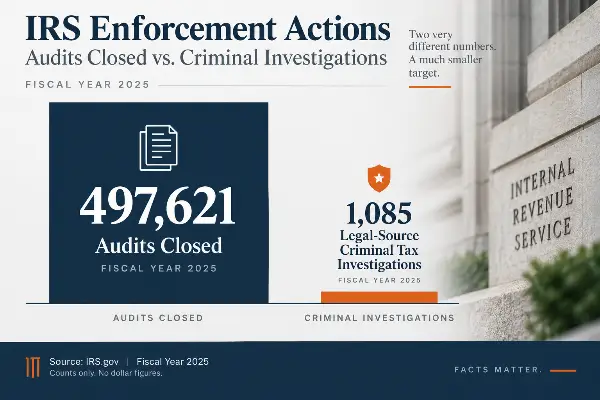
Most audits never get there. Plenty of returns are picked for reasons that have nothing to do with fraud, and who gets audited follows patterns worth knowing. In fiscal year 2025 the IRS closed 497,621 audits, and IRS Criminal Investigation completed 2,850 investigations, 1,085 of which were legal-source tax crimes. So the odds are on your side. But if you’re reading this because you already know what’s on the return, you’re not in the general population anymore, and the ordinary audit advice doesn’t fit your situation.
An eggshell audit is a civil IRS examination in which the taxpayer knows the return contains errors or omissions that could support a criminal tax charge, while the IRS examiner does not yet know. The audit looks routine. The exposure is criminal. A reverse eggshell audit is the same situation, except the IRS already has the damaging information.
A reverse eggshell audit is worse, and it’s the one people miss. There, the IRS already has what it needs from a bank, a business partner, an informant, or another agency. The audit is a test of whether you’ll tell the truth. Every answer you give is being measured against a file you haven’t seen.

What is an eggshell audit?
An eggshell audit is a civil audit carrying criminal risk that only one side can see. The name comes from how the representation feels: every step has to land carefully, because the wrong move breaks something that can’t be put back.
The trigger is usually one of a short list. Cash income that never hit a deposit. Personal spending run through a business. A payroll account that got borrowed from. Crypto sales nobody reported. A return signed with a number the taxpayer knew was low. It lands hardest on small business owners, where the personal accounts and the business accounts have never been fully separate.
None of that is unusual. What makes it an eggshell audit is knowledge. If you know, and the IRS doesn’t, you’re in one right now, whether or not anyone has used the phrase.
Here is how the 3 situations differ.
| Situation | What you know | What the IRS knows | The main risk | The right first move |
|---|---|---|---|---|
| Ordinary audit | The return is accurate | Nothing unusual | Extra tax, interest, a penalty | Send the records, answer the questions |
| Eggshell audit | The return has a real problem | Not yet | Your own words and documents build the fraud case | Stop, get counsel before you respond |
| Reverse eggshell audit | The return has a real problem | Already has the proof | A false answer becomes a separate crime | Stop, and assume every answer is being tested |
How often does an IRS audit actually turn criminal?
Rarely. The IRS closed 497,621 audits in fiscal 2025 and produced $26.8 billion in recommended additional tax, according to the agency’s own compliance figures. Over the same year, IRS Criminal Investigation completed 2,850 investigations: 1,085 legal-source tax crimes, 1,195 illegal-source financial crimes, and 570 narcotics cases.
Put those next to each other and the picture is clear. The overwhelming majority of audits end in a number, not a charge. That number arrives as a proposed adjustment, and you get 90 days to challenge it in Tax Court if you disagree.
The direction of travel is worth watching, though. IRS-CI reported $4.5 billion in identified tax fraud in fiscal 2025, up 111.8 percent over the prior year, alongside a 25 percent increase in search warrants and a 14 percent increase in prosecution referrals. Fewer cases, pursued harder.
So the honest framing is this. Panic is not warranted. Improvising is.
The 3 moves that turn a bad return into a criminal case
In an eggshell audit, what usually creates the criminal exposure isn’t the original return. It’s what the taxpayer does in the first week after the letter arrives. 3 moves do most of the damage.
Move 1: calling your own accountant first. This feels like the responsible thing to do. It’s the single most damaging call available to you, and the next section explains why.
Move 2: answering the “why” question. Examiners ask about intent in plain language. Why did you record it that way? Did you know that wasn’t deductible? Who told you to do it? Those aren’t small-talk questions. Willfulness is what separates a civil penalty from a felony charge, and it’s proved with the taxpayer’s own words more often than with documents.
Move 3: filing a quiet amended return mid-audit. People do this hoping to close the gap before anyone notices. An amended return filed after an audit starts doesn’t erase the original. It can be read as knowledge that the original was wrong, which is exactly the element the government needs. There are ways to correct a return that help you, and a Form 1040-X dropped in the mail during an open examination usually isn’t one of them. If you’re considering it, understand what actually happens after you file an amended return before you sign anything.
None of these 3 moves looks reckless from the inside. All 3 are avoidable.

Can your accountant be forced to testify against you?
Yes. There’s a tax practitioner privilege, and it stops exactly where you need it most.
Under 26 U.S.C. 7525, the confidentiality privilege between a taxpayer and a federally authorized tax practitioner “may only be asserted in any noncriminal tax matter before the Internal Revenue Service” and “any noncriminal tax proceeding in Federal court.” Read that again. Noncriminal. The moment a criminal issue enters, the privilege that covers your CPA or enrolled agent stops applying.
Which means the person who knows the most about your return can be summoned, questioned, and put in front of a grand jury. Your accountant isn’t betraying you when that happens. They have no legal ground to refuse.
Attorney-client privilege is different, and it holds in criminal matters. That’s the practical reason the order of your phone calls matters more than the content of the first one. It’s also why the difference between a tax attorney and a CPA stops being an academic question the second criminal exposure is on the table.
Here is where each professional’s protection stops.
| Who is involved | Protects you in a civil IRS matter | Protects you in a criminal tax matter | Who must hire them |
|---|---|---|---|
| CPA or enrolled agent you hired | Yes, under IRC 7525 | No | You |
| Tax attorney you hired | Yes, attorney-client privilege | Yes | You |
| Accountant under a Kovel engagement | Yes | Yes, through the attorney | The attorney, not you |
There is a way to bring an accountant inside the protected circle. In United States v. Kovel, 296 F.2d 918 (2d Cir. 1961), the court recognized that an accountant hired by the attorney, to help the attorney give legal advice, can fall under attorney-client privilege. That arrangement is usually called a Kovel engagement. The sequence is what makes it work: the attorney retains the accountant. If you hire the accountant yourself and the lawyer shows up later, the protection generally isn’t there.

What are the badges of fraud the IRS looks for?
Badges of fraud are the specific behaviors IRS examiners are trained to spot as signs that an error was deliberate. The agency groups them in its fraud handbook at IRM 25.1.2, and the categories are:
- Income: omitted receipts, hidden accounts, unexplained cash
- Expenses and deductions: deductions for things that never happened, personal costs claimed as business
- Books and records: 2 sets of books, false entries, altered or destroyed documents
- Allocations of income: fictitious partners, income shifted to related parties
- Conduct of the taxpayer: false statements to the examiner, destroying records, obstruction
- Methods of concealment: nominee accounts, asset transfers, secret accounts
- Digital asset fraud: unreported transactions, misvalued holdings, privacy coins
One badge on its own usually isn’t fatal. Examiners look for a pattern, and they look hardest at conduct. A single bad deduction is a math fight. A bad deduction plus a changed story plus a missing ledger is a fraud development case.
The IRS draws a line between indicators of fraud and affirmative acts. Indicators raise a question. Affirmative acts, which the manual calls firm indications, are the concrete steps you took to deceive. That line decides which direction your audit goes.
How do you know your audit has gone criminal?
The clearest sign is that the audit stops. When an examiner establishes affirmative acts of fraud, the manual instructs them to suspend the examination and notify their group manager and a Fraud Enforcement Advisor. The advisor recommends a referral to Criminal Investigation if the criminal criteria are met.
What that looks like from your side of the table:
- Your examiner goes quiet. Calls aren’t returned. Deadlines pass with no follow-up. This is the loudest signal there is, and most people read it as good news.
- Document requests get broader and older, reaching into years that weren’t part of the original scope.
- The questions turn from what to why. Intent questions mean somebody is building a willfulness record.
- A third party gets a summons. Your bank, your bookkeeper, your customers. Note the word: the IRS issues summonses in an examination, not subpoenas. That distinction matters because a third-party summons carries deadlines under 26 U.S.C. 7609. You must be given notice within 3 days of service and no later than the 23rd day before the date set in the summons, and you have until the 20th day after that notice to file a petition to quash it. That’s a real window, and it closes fast.
- New faces appear. An IRS special agent carries a badge and works criminal cases. If one contacts you, the civil stage is over.
Behind the scenes, the machinery has names and clocks. Form 11661 puts a case into fraud development status. Form 2797 is the referral report sent to Criminal Investigation. Under IRM 25.1.3, a special agent schedules an initial conference with the referring employee within 10 workdays, and a disposition conference decides whether the referral is accepted or declined within 30 workdays.
You will not be invited to any of those meetings.
Does the IRS have to tell you it’s investigating you?
No, and this is where a lot of published advice gets it backwards. You’ll find articles claiming the IRS must notify you when a civil audit turns criminal. The manual says otherwise.
IRM 25.1.3 directs the compliance employee to suspend the examination or collection activity “without disclosing to the taxpayer or representative the reason.” Examiners can decline to answer questions about criminal potential, and they have no duty to raise it on their own.
There’s one limit worth knowing. The same section says examiners may not deceive a taxpayer who asks specifically about the character or nature of the investigation. So a direct question gets a truthful answer, or no answer. Silence is the default, and silence is legal.
Read that as a planning fact, not a scare. The system is built so the taxpayer finds out last. Anyone who tells you the government owes you a heads-up is giving you advice that could cost you the case.

What Michigan adds to a federal eggshell audit in 2026
Michigan runs a separate case, under separate law, with its own prosecutors. Every national article on this topic treats an eggshell audit as a purely federal problem. For a Michigan business owner, that’s half the picture.
Under MCL 205.27, filing a false or fraudulent return, or aiding someone else’s tax evasion, with intent to defraud or evade is a felony in Michigan. The penalty is a fine of not more than $5,000, imprisonment for not more than 5 years, or both. Knowingly swearing to a false return with intent to defraud the state is separately punishable as perjury. Both the Michigan attorney general and county prosecutors can bring the case.
That’s not a copy of the federal charge. It’s a second one.
There’s also a reporting trap on the back end. When a federal audit produces a final determination, Michigan expects to hear about it. For federal partnership-level adjustments, the Treasury’s guidance on 2022 Public Act 148 sets a 90-day deadline to report the preliminary information and elect a reporting method, and a 180-day deadline for members to report and pay, under MCL 206.325 and MCL 206.721 through 206.729. Miss it and you can pick up interest and penalties on top of the federal result.
So the federal resolution you worked for doesn’t close the file. It starts a clock in Lansing. Settle the federal case without planning for the state one and you can hand Michigan a finished case file on the same facts.
What to do in the first week
The order matters more than any single step in it. This is the sequence that protects you.
- Stop responding. Don’t answer the examiner’s questions, don’t send the requested records, and don’t call to explain. You can say you’re getting representation and that someone will be in touch. That’s a complete answer.
- Call a tax attorney before you call your accountant. Attorney-client privilege covers criminal matters. The 7525 practitioner privilege doesn’t. Order of operations decides what stays protected, and getting that sequence right is the first thing real audit representation is for.
- Tell the attorney everything, including the part you’re embarrassed about. A lawyer who learns about the second set of books from the IRS can’t help you. One who knows on day 1 can.
- Preserve every record. Don’t tidy, don’t reconstruct, don’t delete. Destroying or altering records is its own badge of fraud, and it converts a defensible case into an indefensible one. If you’re unsure how long to keep records, the answer is longer than most people assume while an examination is open.
- Let counsel decide about amending. Sometimes correcting the record is the right move. Sometimes it’s a confession with a form number. That call isn’t yours to make alone, and it usually belongs inside a wider plan to get back into compliance.
- Deal with the state deliberately. Michigan exposure gets planned for at the start, not discovered at the end.
If your audit is ordinary and you’re worried about nothing, that’s worth finding out too. Plenty of people arrive convinced they’re in trouble when they’re facing a routine examination with a predictable timeline. Knowing which situation you’re in is the first useful thing a professional does for you.
Get a straight read on your audit
Austin & Larson Tax Resolution represents Michigan taxpayers in IRS examinations from offices in Brighton, Saginaw, Lansing, and Jackson. If your audit letter has arrived and you already know what’s on the return, the conversation to have is the one before you answer the IRS. Call (866) 668-2953 or request a no-cost consultation to talk through where you actually stand.
This article is general information about IRS and Michigan tax procedure. It isn’t legal advice, and reading it doesn’t create an attorney-client relationship.
FAQs
Is an eggshell audit a crime?
No. An eggshell audit is a civil examination, not a charge. The term describes the risk, which is that the audit could produce evidence supporting a criminal tax case. Most audits don’t. The IRS closed 497,621 audits in fiscal 2025, while IRS Criminal Investigation completed 1,085 legal-source tax crime investigations in the same period.
What is the difference between an eggshell audit and a reverse eggshell audit?
In an eggshell audit, you know about the problem on the return and the IRS doesn’t. In a reverse eggshell audit, the IRS already has the damaging information, usually from a bank, a third party, or another agency, and the audit is being used to test your answers. The second is more dangerous because you’re responding to a record you can’t see.
Will the IRS tell me if my audit becomes a criminal investigation?
No. IRM 25.1.3 directs IRS employees to suspend the examination without disclosing the reason to the taxpayer or representative. Examiners can’t deceive you if you ask directly about the nature of the investigation, but nobody is required to volunteer it. The audit going quiet is often the only signal you get.
Can my CPA be forced to testify against me?
Yes. The tax practitioner privilege in 26 U.S.C. 7525 applies only in noncriminal tax matters before the IRS and noncriminal federal court proceedings. Once criminal exposure is involved, your accountant can be summoned and questioned. An attorney can bring an accountant under attorney-client privilege through a Kovel engagement, but the attorney has to hire the accountant.
Should I amend my return before the IRS finds the error?
Talk to a tax attorney first. An amended return filed during an open examination doesn’t undo the original return and can be used as evidence that you knew it was wrong. Timing, wording, and whether a voluntary disclosure fits your facts all change the answer. This is not a form to file on your own instinct.
What are the warning signs that my IRS audit has gone criminal?
The examiner stops responding, document requests expand into years outside the original scope, questions shift from what you claimed to why you claimed it, third parties receive summonses, or a special agent makes contact. Under IRM 25.1.2, an examiner who establishes affirmative acts of fraud is instructed to suspend activity and notify a Fraud Enforcement Advisor.
Can Michigan charge me if the IRS doesn’t?
Yes. Michigan prosecutes tax crimes under its own law. MCL 205.27 makes filing a false or fraudulent return with intent to defraud or evade a felony carrying up to 5 years in prison, a fine, or both, and both the attorney general and county prosecutors can bring charges. A federal resolution does not close the state’s file.

Bridgette Austin, Esq., EA, spent three years at Michigan State University’s Tax Clinic representing low-income taxpayers before the IRS – two as a student clinician, one as a post-graduate fellow. That work shaped her practice. A Bellaire, Michigan native with a Northern Michigan University bachelor’s and an MSU law degree, she now resolves IRS and State of Michigan tax debt cases at Austin & Larson.
Recent Comments