

Written By: Michael Vale
Reviewed By: Bridgette Austin, Esq., EA, Co-Founder and Tax Attorney
Last Reviewed: November 2, 2026
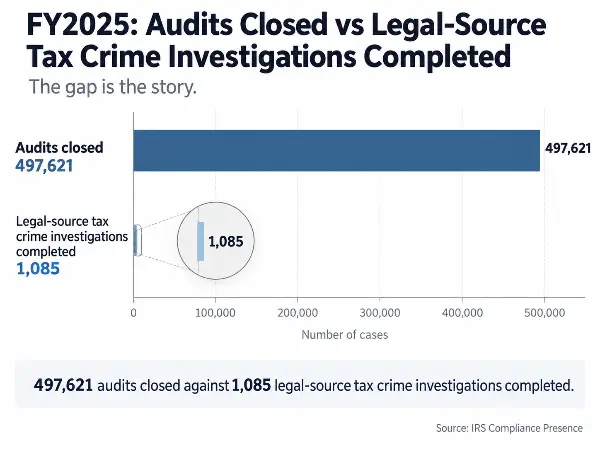
The difference between a tax audit and a criminal tax investigation is what the government is trying to prove. An audit asks whether your numbers are right. A criminal investigation asks whether you broke the law on purpose. One ends with a bill. The other can end with a federal charge. Most people who open that letter assume they’re already in the second group. Almost nobody is. The IRS closed 497,621 audits in FY2025. IRS Criminal Investigation completed 1,085 legal-source tax crime cases. Here’s how to tell which file you’re in, what changes if it moves, and what Michigan adds on top.

What is the difference between a tax audit and a criminal tax investigation?
A tax audit is a civil examination. A criminal tax investigation is a law enforcement matter.
A tax audit is a civil review of a filed return. It checks that income, deductions and credits were reported correctly, and it ends in tax, penalties and interest. A criminal tax investigation is run by IRS Criminal Investigation. It asks whether a taxpayer broke the tax laws on purpose, and it can end in prosecution and prison.
The fastest way to tell which one you’re in is to look at who’s contacting you. Three different IRS job titles show up in tax cases and they do not do the same work.
| Who contacts you | What they do | What it means for you |
|---|---|---|
| Revenue agent | Examines your return in a civil audit | You’re in an examination. It is about records. |
| Revenue officer | Collects a balance the IRS has already assessed | You’re in collection. The tax is settled, the payment is not. |
| Special agent | Investigates criminal violations for IRS Criminal Investigation | You’re in a criminal matter. Stop and get counsel. |
Neither a revenue agent nor a revenue officer can charge you with a crime. Special agents build the criminal cases. Its FY2025 annual report says IRS-CI is the only federal agency that can investigate criminal violations of the tax code. So if the person contacting you says “special agent,” you’re not in an audit anymore.
That line also sorts out what kind of problem you have. A fight over whether a deduction was documented is a fight about records. A fight over whether you knew the income was there and left it off anyway is a fight about what you were thinking. If you’re still working out what a tax audit involves, start there, and our breakdown of legal planning versus illegal underreporting covers where that line falls.
How often does an IRS audit turn into a criminal case?
Rarely. The numbers are not close.
The IRS closed 497,621 tax return audits in FY2025. That figure comes from the Compliance Presence data the IRS published on 5 June 2026. Over the same year, IRS Criminal Investigation completed 2,850 investigations. Only 1,085 of those were legal-source tax crimes. The rest were illegal-source financial crime and narcotics cases. Most of those never started as somebody’s audit.
So here’s the shape of it. A civil audit is the normal outcome. A criminal referral is the exception, and it’s one the IRS has to build.
But when a case does go criminal, the government usually finishes it. IRS-CI reported an 89% conviction rate for FY2025. It reported a 76% incarceration rate and an average of 49 months to serve. Both things are true at once. The odds of getting there are low. The odds of walking away once you’re there are low too.
So the useful question isn’t how scared to be. It’s which file you’re in right now.
Most audits stay routine because most audits are about paperwork. Our guide to what actually triggers an audit covers the common reasons. The different audit formats explains why a mail audit and a field audit feel so different.
What changes the moment your case gets referred
A referral doesn’t start with a phone call to you. It starts inside the IRS. The first thing you notice is that your audit goes quiet.
Here’s the sequence, which almost nobody publishes. Internal Revenue Manual 25.1.2.2(9) covers what happens when firm indications of fraud turn up. The employee “must suspend collection or examination activity, and immediately notify the group manager and the FEA.” FEA stands for Fraud Enforcement Advisor. The FEA is the one who then recommends a referral to Criminal Investigation.
Read that again. Your revenue agent doesn’t refer your case. They stop, and they hand it up. The referral travels on Form 2797, the Referral Report of Potential Criminal Fraud Cases. It passes the group manager, the FEA and the FEA group manager before a CI field office ever sees it.
What sets this off isn’t one bad year. IRM 25.1.2.3 sorts the fraud indicators into 6 groups: income, expenses or deductions, books and records, allocations of income, conduct of the taxpayer, and methods of concealment. Conduct is on that list. That’s why how you handle an audit can matter as much as what’s on the return.
The signal you’ll actually notice is silence. Your examiner stops returning calls. Deadlines pass with no follow-up. Nothing comes in the mail. People read that as the IRS losing interest. It’s the opposite.

Does the IRS have to tell you the audit went criminal?
No. But if you ask directly, they are not allowed to lie to you.
This is the part the rest of the internet gets wrong, and it cuts both ways. IRM 25.1.3.3(3) tells the employee to suspend the exam “without disclosing to the taxpayer or representative the reason for the suspension.” The same section says employees “are not required to initiate disclosure” about fraud indicators or a possible CI referral. They “may decline to answer questions about criminal potential.” So nobody owes you a warning.
Then comes the sentence that matters. Those same employees “may not deceive taxpayers when asked specifically about the character or nature of an investigation.”
Put plainly: silence is allowed. A dodge is allowed. A lie is not.
If your audit has gone quiet, your representative can put the question in writing. You’ll get an answer or a refusal to answer. Both tell you something. Waiting and hoping tells you nothing.
Civil fraud and criminal fraud are two different problems
They are not two severities of the same thing. They are separate proceedings with separate burdens and separate deadlines, and you can face both.
| What differs | Civil fraud case | Criminal tax case |
|---|---|---|
| What must be proved | The underpayment was due to fraud | You willfully broke a specific tax law |
| Standard of proof | Clear and convincing evidence | Beyond a reasonable doubt |
| Who carries the burden | The IRS, under IRC 7454(a) | The government |
| Penalty | 75% of the fraudulent underpayment, IRC 6663 | Fines and prison |
| Deadline to act | None. IRC 6501(c)(1) allows assessment at any time | 6 years from the offense, IRC 6531 |
| How it ends | An assessment you owe | A conviction, or no charge at all |
Start with the civil side. IRC 6663 adds a penalty of 75% of the part of the underpayment caused by fraud. The government carries the burden of proof there, not you. IRC 7454(a) puts “the burden of proof in respect of such issue” on the Secretary. The standard is clear and convincing evidence. In a criminal case the standard climbs again, to beyond a reasonable doubt. That’s why the government charges far fewer cases than it could.
The clocks differ too. This is the part that surprises people.
The IRS normally has 3 years to assess tax under IRC 6501(a). That stretches to 6 years if you left out more than 25% of your gross income. But IRC 6501(c)(1) covers “a false or fraudulent return with the intent to evade tax.” In that case the tax may be assessed “at any time.” No deadline at all.
Criminal charges run the other way. IRC 6531 gives the government 6 years for evasion, false returns and willful failure to file. That clock starts when the offense was committed.
So a criminal case can run out of time while the civil file stays open forever. That’s a real outcome, and it’s why “the statute ran” is rarely the end of the story. Our post on the penalties for tax evasion walks through both sets of consequences.

Michigan runs a second track, and 2026 has not changed it
A federal resolution doesn’t close your Michigan file. No national article on this topic covers that, and it’s the part that catches Michigan business owners.
MCL 205.27 makes it a felony to file a false or fraudulent return, or to help someone else try to evade a tax, when it’s done with intent to defraud or evade. That carries up to 5 years. Knowingly breaking other provisions without that intent is a misdemeanor of up to 1 year. It’s a state charge under state law. Nothing in a federal closing agreement touches it.
The state has its own investigators. Michigan Treasury says its Tax Enforcement Unit “concentrates on civil and criminal investigation and prosecution of tax fraud cases.” It works with the Michigan State Police, other law enforcement, and the Attorney General. Treasury also runs a Discovery Unit that finds non-filers and under-reporters and handles voluntary disclosure.
Two things follow. If you’re under federal exam in Michigan, assume the state can look at the same years. And the order you resolve things in matters, because what you say to settle the federal file doesn’t stay in the federal file. That double exposure lands hardest on Michigan business owners, who file payroll and sales tax returns with the state as well as income tax with the IRS.

Why writing a check does not end a criminal case
Paying the tax closes the civil balance. It does not close a criminal investigation, and in some situations it makes things worse.
A criminal tax case is about willfulness, not about the balance. Once a referral is accepted, paying the assessment clears the debt but leaves the conduct. The conduct is what’s being investigated. Prosecutors treat the tax loss as a sentencing measure, not as the charge.
The bigger problem is what paying looks like. Amending a return mid-audit, or quietly paying a year you’d left alone, is an act. It can read as a correction. It can also read as an admission. Which one depends on timing and on what the government already knows. That’s a call to make with counsel before you file, not after.
If a revenue officer is already assigned to your case, collection has its own rules and its own risks. Our guide to dealing with a revenue officer covers what they can and can’t do.
The first call you make matters more than the last one
Most of the damage in these cases happens in the first week, and it usually happens on a phone call to the wrong person.
The instinct is to call the accountant who prepared the return. In a routine audit, that’s fine. In a case with criminal exposure it’s the worst move available, because the protection people assume they have isn’t there.
IRC 7525 does give a confidentiality privilege to federally authorized tax practitioners. But 7525(a)(2) says it “may only be asserted in” a “noncriminal tax matter before the Internal Revenue Service” and a “noncriminal tax proceeding in Federal court.” So the privilege ends the moment criminal exposure begins. Your accountant can then be made a witness against you.
Attorney-client privilege has no such limit. An accountant can be brought under it when they’re engaged through counsel. Our comparison of a tax attorney and a CPA sets out what each one can and can’t do.
If your audit has gone quiet, or a special agent has made contact, the order is simple. Stop volunteering information. Don’t amend anything. Don’t talk the facts through with your preparer. And get the question asked properly about what kind of investigation you’re in.
Austin & Larson Tax Resolution handles audit representation for people and businesses across Michigan, with offices in Brighton, Lansing, Jackson and Saginaw. Maybe your audit went silent. Maybe a special agent called. Maybe you just don’t know which file you’re in. Either way, settle the difference between a tax audit and a criminal tax investigation before you say anything else. Call (866) 668-2953 or book a time to talk and bring the notice with you.
FAQs
What is the difference between a tax audit and a criminal tax investigation?
An audit is a civil review of whether your return is accurate, and it ends in tax, penalties and interest. A criminal tax investigation is run by IRS Criminal Investigation to determine whether you willfully broke the law, and it can end in prosecution. In FY2025 the IRS closed 497,621 audits while IRS-CI completed 1,085 legal-source tax crime cases.
Can an IRS audit send me to prison?
An audit by itself cannot. Prison only follows a criminal case brought by the Department of Justice after an IRS-CI investigation and a conviction. IRS-CI reported an 89% conviction rate and a 76% incarceration rate in FY2025, with an average of 49 months to serve, so the cases that get charged are serious. Getting audited is not the same as being charged.
How do I know if my audit has become a criminal investigation?
The most common signal is silence. Under IRM 25.1.2.2(9) the examiner must suspend activity and notify the group manager and the Fraud Enforcement Advisor when firm indications of fraud appear, and IRM 25.1.3.3(3) tells them to suspend without disclosing to the taxpayer or representative the reason for the suspension. A special agent making contact is the clearest sign of all.
Does the IRS have to tell me if I am under criminal investigation?
No. IRS employees are not required to initiate disclosure about a potential referral and may decline to answer questions about criminal potential. But IRM 25.1.3.3(3) also says they may not deceive taxpayers when asked specifically about the character or nature of an investigation, so a direct question through your representative has to get an honest answer or a refusal.
Will paying the tax stop a criminal tax investigation?
No. Paying settles the civil balance, but a criminal case turns on willfulness rather than on the amount owed, so the conduct remains under investigation. Amending a return or paying a year mid-audit can also be read as an admission, which is why that decision belongs with counsel first.
Does Michigan run its own tax investigation?
Yes. Michigan Treasury’s Tax Enforcement Unit conducts civil and criminal investigation and prosecution of tax fraud cases alongside the Michigan State Police and the Attorney General. Under MCL 205.27 a false or fraudulent return filed with intent to defraud or evade is a felony carrying up to 5 years, and a federal resolution does not close the state file.
Should I call my accountant or a tax attorney first?
Call the attorney. IRC 7525(a)(2) limits the tax practitioner privilege to noncriminal matters before the IRS and noncriminal federal proceedings, so it disappears exactly when you need it and your accountant can be compelled to testify. Attorney-client privilege does not carry that limit, and an accountant can be brought under it when engaged through counsel.

Bridgette Austin, Esq., EA, spent three years at Michigan State University’s Tax Clinic representing low-income taxpayers before the IRS – two as a student clinician, one as a post-graduate fellow. That work shaped her practice. A Bellaire, Michigan native with a Northern Michigan University bachelor’s and an MSU law degree, she now resolves IRS and State of Michigan tax debt cases at Austin & Larson.
Recent Comments