

Written By: Michael Vale
Reviewed By: Bridgette Austin, Esq., EA, Co-Founder and Tax Attorney
Last Reviewed: August 15, 2026
Yes. The IRS can garnish Social Security. It uses a program called the Federal Payment Levy Program to take 15% of your monthly retirement, disability (SSDI), or survivors benefit for unpaid federal taxes. It does this automatically, without a court order.
But 15% is not the whole story, and most articles stop there. That 15% is only the cap on the automated program. If the IRS assigns a Revenue Officer to your case, a manual levy can take much more, in some cases nearly your whole check. One benefit is fully protected: Supplemental Security Income (SSI). Here is exactly what the IRS can reach, how to tell which kind of levy you face, and how to stop it.
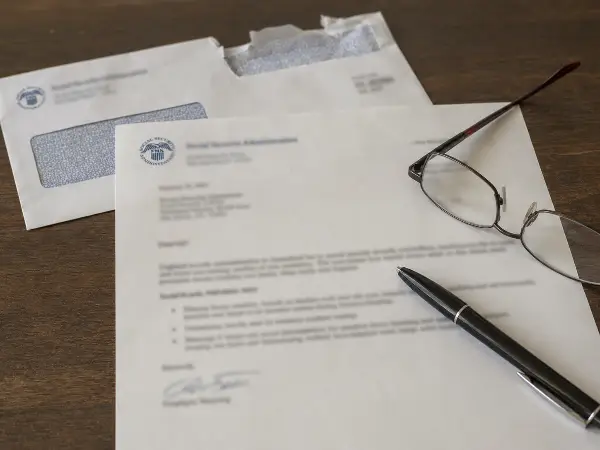
What is a Social Security levy?
A Social Security levy is the IRS legally seizing part of your monthly benefit to collect unpaid federal taxes. The IRS calls it a levy. Most people call it garnishment. It pulls a set amount from each payment before the money reaches your bank account, and it keeps going until the debt is paid or you put a resolution in place.
Congress lets the IRS do this under the Internal Revenue Code, sections 6331 and 6334. Social Security is not on the list of income the law fully protects, so it becomes a target once you fall behind.
Which Social Security benefits can the IRS take?
The IRS can levy most Social Security benefits. It cannot touch needs-based or child benefits. Here is the full picture, which is more than the usual “retirement yes, SSI no” split.
| Benefit type | Can the IRS levy it? | How much |
|---|---|---|
| Social Security retirement | Yes | 15% automated, more under a manual levy |
| Social Security Disability (SSDI) | Yes | 15% automated, more under a manual levy |
| Survivors benefits (adult) | Yes | 15% automated, more under a manual levy |
| Survivors benefits paid to a child | No | Exempt |
| Lump-sum death benefit | No | Exempt |
| Supplemental Security Income (SSI) | No | Exempt |
| Veterans (VA) benefits | Generally no | Exempt in most cases |
The key line people miss: SSDI is not protected. It sits in the same legal category as retirement (a Title II benefit), so the IRS can take it. Only SSI, which is needs-based, is off-limits. If you are not sure which one you receive, check your award letter or call the SSA at 1-800-772-1213.
How much can the IRS take from Social Security in 2026?
It depends on which type of levy the IRS uses, and this is where the common answer is only half right. There are two, and they follow different rules.
| Levy type | Legal authority | How it starts | What the IRS can take |
|---|---|---|---|
| Automated (FPLP) | IRC 6331(h) | A computer match. No person assigned. | 15% of each monthly payment |
| Manual | IRC 6331(a) | A Revenue Officer is assigned to your case | No percentage cap. Most of the check above a small exempt floor |
Under the automated program, the math is simple: 15% of each monthly payment, taken before the money reaches your bank account. There is no minimum benefit that makes you exempt. A smaller check gets levied at the same 15% rate as a larger one.
A manual levy is a different animal. When a Revenue Officer handles your case, the 15% cap does not apply. The law only shields a small exempt amount, figured from the standard deduction and published each year by the IRS in Publication 1494. The IRS can take everything above that floor. So the honest answer to “how much” is: 15% if it is automated, and potentially most of your check if it is manual.
This is the single most important thing to understand, and it is why “the IRS can only take 15%” is dangerous advice. That number is a ceiling only for the hands-off program.

Automated or manual: how do you tell which levy you are facing?
Look at whether a real person is working your case. That is the tell.
If you are getting computer-generated notices in the mail and no one from the IRS has contacted you directly, you are most likely in the automated FPLP track, capped at 15%. If a Revenue Officer has called you, left a business card, shown up, or sent a letter with their name and direct number, your case is assigned to a person. That is the manual track, and the 15% cap is off the table.
Revenue Officers get assigned to larger balances, older debts, and cases the automated system could not close. If you have one, treat it as urgent. The amount at risk each month just went up, not down.

Will the IRS warn you before it levies your Social Security?
Yes. The IRS has to send a Final Notice of Intent to Levy at least 30 days before it takes your benefits. For Social Security, this is usually a CP91 or CP298. In some cases you will get a CP90, CP297, or an LT11 instead. They all do the same two things: warn you, and tell you about your right to a Collection Due Process hearing.
That 30-day window is your best chance to act. Request a Collection Due Process hearing in time and the levy is put on hold while your appeal is reviewed. Miss the deadline and you lose that specific option, though others still exist. Before any of these final notices, the IRS also sends earlier reminders (CP14, then CP501 and CP503), so a levy is rarely the first you hear of the problem.
How do you know if your Social Security is already being levied?
Compare your latest deposit to your normal benefit. A drop of exactly 15% is a strong sign the automated levy has started. A larger, harder-to-explain drop can point to a manual levy.
You can confirm it two ways. Call the SSA at 1-800-772-1213 and ask whether a federal levy is on your record. Or pull your IRS account transcript, which shows levy activity. If the money is already coming out, you can still stop future months. A levy release is not off the table just because it has begun.

How do you stop an IRS levy on Social Security?
You stop it by putting a formal resolution in place. Asking the IRS to stop, with nothing behind the request, rarely works. Matching the right resolution to your income and assets is the core of how we handle IRS levies and wage garnishments.
Installment agreement. A formal payment plan usually gets the levy released once it is active and accepted. A plan you mention on the phone but have not set up does not count.
Currently Not Collectible (CNC). If Social Security is most or all of your income and the levy makes basic bills unaffordable, the IRS can pause collection entirely. The levy stops while the status holds. The debt does not vanish, but the pressure comes off.
Offer in Compromise (OIC). If your income and assets are low enough, you may settle for less than the full balance. Retirees on fixed income often screen well here, because the IRS bases the figure on what it can realistically collect from you.
Collection Due Process appeal. If you got a Final Notice but the levy has not hit yet, a timely hearing request stops it during the appeal. The deadline is strict.
What if Social Security is your only income?
That usually helps your case, not hurts it. The IRS has to weigh whether a levy leaves you unable to cover basic living costs. When Social Security is all you have, that is often a strong argument for Currently Not Collectible status or an Offer in Compromise.
Here is the part few articles mention. The IRS generally has 10 years from the date a tax is assessed to collect it. That deadline is called the Collection Statute Expiration Date. If you are in CNC status when the clock runs out, the remaining balance legally expires and the IRS writes it off. For a retiree with little income and few assets, sometimes the strongest math is not paying at all. It is staying in a protected status until the debt times out. Interest still adds up in the meantime, so this only works when the numbers and the calendar line up. It is worth checking your assessment dates before you assume you have to pay.
Can you settle a tax debt if you are retired on a fixed income?
Often, yes, but go in with real expectations. Retirees can be good Offer in Compromise candidates because the IRS calculates the settlement from your actual income and assets, and a fixed-income household with modest savings may qualify to pay far less than the balance.
Expectations matter because the odds tightened. The IRS accepted about 21% of Offers in Compromise in 2024 (7,199 of 33,591), down sharply from roughly 42% the year before. Preparation quality is a big part of the difference. An OIC runs on Form 656 and a detailed financial statement, Form 433-A (OIC), and a thin or sloppy package gets rejected. This is not a form to guess your way through.

How these cases get handled
When our team takes on a Social Security levy, we start with the full financial picture: income, allowable living expenses, asset values, and the balance owed. For many retirees, the answer is Currently Not Collectible status or an Offer in Compromise. For others, a payment plan sized to real income is the cleaner fix.
We also confirm which levy you are facing, because that changes the urgency and the plan. A Revenue Officer case is handled very differently from an automated one. We work under a written agreement, deal with the IRS directly so you do not have to, and tell you what is happening at each step. The first consultation is free and confidential.
If your check is already shrinking, do not wait for next month’s to confirm it. The sooner you get experienced Michigan tax help working the case, the more options stay open.
FAQs
Can the IRS really take my Social Security retirement check?
Yes. Through the Federal Payment Levy Program, the IRS can automatically take up to 15% of your monthly Social Security retirement benefit for unpaid federal taxes, with no court order. If a Revenue Officer is assigned to your case, a manual levy can take more than 15%. The levy continues until the debt is resolved or the IRS releases it. A formal installment agreement is the most direct way to stop it.
Is Social Security Disability (SSDI) protected from an IRS levy?
No. SSDI is not protected. It is a Title II benefit, the same category as retirement, so the IRS can levy it under the same rules. Only Supplemental Security Income (SSI) is exempt. SSDI and SSI are different programs. If you are not sure which you receive, check your award letter or call the SSA at 1-800-772-1213.
What is the most the IRS can take from Social Security?
Under the automated program, 15% of each monthly payment. But that cap only applies to the automated Federal Payment Levy Program. A manual levy run by a Revenue Officer under a different part of the law has no percentage cap and can take most of your check above a small exempt amount set by IRS Publication 1494. So 15% is the floor of your risk, not always the ceiling.
How do I know if the IRS has already levied my Social Security?
Compare your latest deposit to your normal benefit. A drop of exactly 15% strongly suggests the automated levy is active. You can confirm by calling the SSA at 1-800-772-1213 or by pulling your IRS account transcript. The IRS should also have mailed you a Final Notice of Intent to Levy, usually a CP91 or CP298, before it began.
Can I get an IRS levy on my Social Security stopped quickly?
Yes, but it takes a specific action, not just a phone call. The fastest routes are an active installment agreement or a hardship-based levy release. A tax professional can speed this up by submitting the right financial forms and the resolution request in one organized step instead of several scattered IRS calls.
What if Social Security is my only income?
That often supports Currently Not Collectible status or an Offer in Compromise, because the IRS must consider whether the levy leaves you unable to pay for necessities. There is also a timing angle: the IRS generally has 10 years to collect, and a balance can expire while you are in a protected status. Documenting the hardship correctly is the key step.
Can I settle a tax debt if I am retired on a fixed income?
Yes. Retirees are often strong Offer in Compromise candidates because the IRS bases the settlement on your actual income and assets. Expect scrutiny, though. The IRS accepted about 21% of Offers in 2024, down from roughly 42% in 2023, and preparation quality drives the outcome. An OIC uses Form 656 and Form 433-A (OIC).

Bridgette Austin, Esq., EA, spent three years at Michigan State University’s Tax Clinic representing low-income taxpayers before the IRS – two as a student clinician, one as a post-graduate fellow. That work shaped her practice. A Bellaire, Michigan native with a Northern Michigan University bachelor’s and an MSU law degree, she now resolves IRS and State of Michigan tax debt cases at Austin & Larson.
Recent Comments