

Written By: Michael Vale
Reviewed By: Bridgette Austin, Esq., EA, Co-Founder and Tax Attorney
Last Reviewed: September 28, 2026
Most lists of the signs of an IRS criminal investigation describe the end of the process, not the beginning. Special agents at the door, a search warrant, your bookkeeper getting a phone call. By the time any of that happens, the government has been building the file for months. The first real sign came and went without you, because a bank filed a form about your account and federal law forbids it from telling you.
That is not a theory. IRS Criminal Investigation published its own case-origin numbers in February 2026, and they show where the work starts.
An IRS criminal investigation is a case worked by special agents of IRS Criminal Investigation, the agency’s law enforcement arm, to decide whether a tax or financial crime was committed on purpose. It is separate from an audit. Audits determine what you owe. Criminal investigations determine whether the government will ask a court to punish you.
The first sign is a filing your bank is forbidden to mention
Your bank reports you before the IRS ever contacts you, and it is not allowed to say so.
Two filings do most of the work, and they behave differently.
| Currency transaction report | Suspicious activity report | |
|---|---|---|
| What triggers it | A cash transaction | A transaction the bank thinks may be improper |
| Threshold | More than $10,000 in currency | At least $5,000 in funds or assets |
| Rule | 31 CFR 1010.311 | 31 CFR 1020.320 |
| Judgment involved | None, it is automatic | Yes, the bank decides |
| Are you told | No | No, and disclosure is prohibited |
| Aggregation | Same business day totals count | Related activity can be grouped |
The second column carries the sting. Under the reporting rules, no bank or its employees may disclose a suspicious activity report or any information that would reveal one exists. There is no sign to spot. That is the design.
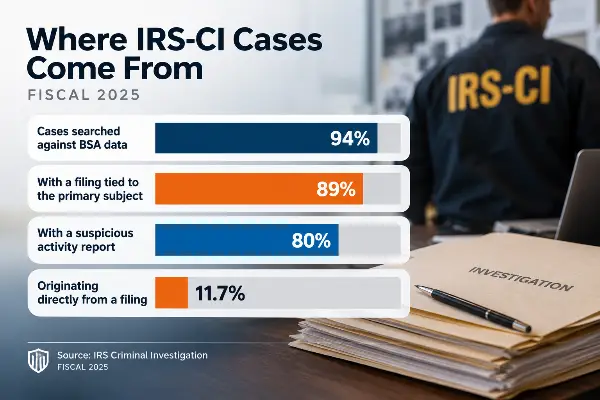
IRS-CI told everyone how much it leans on these filings. In fiscal 2025 it ran more than 3.9 million searches against Bank Secrecy Act data, covering 94% of its cases. Almost 89% of its investigations had a bank filing tied to the primary subject. Nearly 80% involved a subject with a suspicious activity report attached, and 11.7% of investigations started directly from one of these filings.
One detail matters more than the headline number. Of the investigations IRS-CI opened with a currency transaction report attached, 89.1% had at least 1 aggregated report. Aggregation means the bank added your transactions together. Under 31 CFR 1010.313(b), a bank must treat multiple currency transactions as one if it knows they are by or for the same person and total more than $10,000 in a single business day. Splitting a deposit does not avoid the report. It creates a second problem, because structuring transactions to dodge the reporting requirement is its own federal offense.
This lands hardest on cash-heavy operations. Restaurants, salons, contractors, car washes, and anyone who banks a day’s takings. If you run a business that touches currency, the reporting happens whether or not anything is wrong, and business tax matters get a different level of scrutiny than personal ones for exactly that reason.
What IRS criminal investigation numbers look like in 2026
The most recent full picture comes from the IRS-CI annual report for fiscal 2025, released in December 2025. It covers 1 October 2024 through 30 September 2025.
| Stage | Fiscal 2025 |
|---|---|
| Investigations initiated | 2,792 |
| Recommended for prosecution | 2,043 |
| Indictments and informations | 1,726 |
| Defendants sentenced | 1,613 |
| Conviction rate | 89% |
| Incarceration rate | 76% |
| Average months to serve | 49 |
About 3,000 special agents did that work, spending nearly 64% of their time on tax crimes. The agency reported the 89% conviction rate alongside those totals.
Read the top and the bottom of that table together. Roughly 2,800 investigations opened. An 89% conviction rate at the end. The filter is not the trial. The filter is whether IRS-CI decides to recommend your case at all, and almost everything you can do about that happens before you know the case exists.

What signs of an IRS criminal investigation can you actually spot?
The visible signs are real, and every one of them means the case is already underway.
Someone shows you a badge. Special agents identify themselves as IRS Criminal Investigation. They are federal law enforcement officers, they may be armed, and they do not handle balance-due cases. There is no version of an IRS-CI visit that is routine.
Your bank freezes or questions something. By the time an account hold appears, filings have usually been going out for a while.
People around you get called. Vendors, employees, customers, ex-spouses, business partners, your accountant. This is the most common way a subject learns a case exists, and it is covered below.
Your audit goes quiet. An examiner who develops a firm indication of fraud has to suspend the case without telling you why, which is why silence during an active IRS audit is the most reported warning sign in tax practice.
A revenue officer drops the case. Collection work has its own rhythm, and a revenue officer who goes silent mid-negotiation is doing something other than forgetting about you.
One caution on the last item in most published lists. Third parties acting strangely is a prompt to ask direct questions, not evidence by itself. A nervous bookkeeper proves nothing, and neither does a slow laptop or a delayed email. Publishing that sort of thing as a warning sign does frightened people a disservice.
Does a summons from a special agent mean charges are coming?
Most writing on this topic treats an administrative summons signed by a special agent as the darkest signal available. The timing runs the other way, and the Justice Department says so.
Once IRS-CI refers a case to the Department of Justice, the summons power switches off. Under Justice Manual 6-4.110, once a criminal referral is made, the IRS, including CI, may not issue or begin an action to enforce an administrative summons against that taxpayer for the same tax and the same period. A live summons therefore tells you the case has not yet been referred out.
That window is the whole game. It is not comfort, and nobody should read it as good news. It is a fact about where the case sits, and it is the difference between a matter that can still be influenced and one that has moved to prosecutors.
Confirm this read with counsel before acting on it. The rule is about referral status, not about exposure.

Who does the IRS talk to before it talks to you?
Special agents build the case from people around you, which is why other people often find out first.
Banks and credit unions come first, because the filings are already in hand. The accountant or bookkeeper is next, and that conversation is more dangerous than most people expect. The federal practitioner privilege that covers an accountant applies only in noncriminal tax matters. When the matter turns criminal, it is gone, and the accountant becomes a witness with their own lawyer and their own interests. The difference between what a tax attorney and a CPA can protect stops being an abstract distinction at that moment.
After that: vendors, customers, employees, landlords, insurance agents, and family. Agents are not required to keep an investigation confidential from the people they interview. If 3 people mention being asked about your money in the same month, that is a pattern, not a coincidence.
What to do when a special agent makes contact
Stop talking, then call a tax attorney. In that order.
Say nothing beyond confirming who you are. A “voluntary” interview is voluntary in the sense that it can be declined. Declining is not obstruction and it is not an admission.
Do not call the accountant to talk it through. That conversation is not protected and it can turn the person who prepared the returns into the government’s best witness.
Do not destroy, edit, backdate, or reorganise anything. Altering records after learning of an investigation creates a second and cleaner case than the one the government started with. Preserve everything, including email and accounting files, and write down the dates and names of every IRS contact you can recall.
Do not file an amended return to fix the problem alone. Timing rules decide whether that helps or hurts, and getting it wrong mid-investigation reads as an admission.
Ask about voluntary disclosure rather than assuming the door is shut. The IRS Voluntary Disclosure Practice is timely only if the IRS receives the application before it starts a civil exam or criminal investigation, before it gets third-party information about the noncompliance, and before it acquires information from a criminal enforcement action. The IRS says plainly that a voluntary disclosure will not automatically guarantee immunity from prosecution, though it may result in prosecution not being recommended. If a special agent has already called, this option has probably closed, and a lawyer should confirm that rather than the taxpayer guessing.
One more thing worth knowing. The IRS does not owe anyone a warning that a case has turned criminal, and asking plainly, through a representative and in writing, is still worth doing. An answer and a refusal to answer are both information.

How far back a criminal tax case can reach
Longer than most people assume, and longer than the civil audit window.
The criminal statute of limitations for the main tax offenses runs 6 years, not 3, and it runs from when the offense was committed rather than from when the IRS found it. Tax evasion carries up to 5 years in prison. Filing a false return under penalty of perjury carries up to 3. Willful failure to file is a misdemeanor carrying up to 1 year, and a pattern of unfiled years is one of the fact patterns that moves a case from collection to investigation. If that describes the situation, the relevant reading is on unfiled and delinquent returns and on how many years of back returns the IRS can require.
Willfulness is what separates a criminal case from an expensive one. The line between tax avoidance and tax evasion is intent, and intent is proved with documents and with things people said, including things they said to investigators without a lawyer present.
Where a Michigan criminal tax case ends up
A Michigan case does not stop at IRS-CI, and that second gate is one most people never hear about.
IRS-CI investigates and recommends. It does not charge anyone. Federal tax charges in Michigan are brought by the United States Attorney’s Offices for the Eastern and Western Districts of Michigan, and those offices cannot act alone either. Justice Manual 6-4.200 states that the Tax Division must approve any and all criminal charges a United States Attorney’s Office intends to bring for conduct arising under the internal revenue laws.
That creates a real decision point after the investigation and before an indictment. Under Justice Manual 6-4.214, a subject may request a conference with the Tax Division in writing, though the request will be denied if the matter has already gone to the United States Attorney’s Office. The same section carries a warning worth repeating: the government may use any statement made at that conference both to evaluate the matter and in a court proceeding. It is an opportunity and a hazard in the same room, which is why nobody should walk into one alone.
Michigan runs its own track as well. A federal resolution does not automatically close a Michigan Department of Treasury file, and the state has separate authority over false and fraudulent returns.
If the signs of an IRS criminal investigation are showing up, the useful question is not whether they are real. It is how much of the window is left. Austin & Larson Tax Resolution represents Michigan taxpayers and businesses in IRS matters from offices in Brighton, Saginaw, Lansing, and Jackson. Where the contact so far has been an examination rather than a special agent, audit representation is the place to start and a representative can ask the questions.
This article is general information about federal and Michigan tax procedure. It is not legal advice, and reading it does not create an attorney-client relationship.
FAQs
What are the clearest signs of an IRS criminal investigation?
A special agent introducing themselves in person, third parties reporting that the IRS has asked them about you, an account hold at your bank, and an audit that goes silent. Each one means the case is already active. The earliest sign is invisible, because banks file currency and suspicious activity reports without telling you, and almost 89% of IRS-CI investigations in fiscal 2025 had such a filing tied to the primary subject.
Do banks report you to the IRS?
Yes, routinely, and usually without your knowledge. Cash transactions above the reporting threshold generate an automatic currency transaction report, and a bank that considers a transaction improper files a suspicious activity report. The reporting rules prohibit a bank from telling a customer that a suspicious activity report exists.
How long does an IRS criminal investigation take?
Months to years. IRS-CI initiated 2,792 investigations in fiscal 2025 and recommended 2,043 for prosecution, and cases are built from bank records, third-party interviews, and document reviews that take time. The length is not a sign of weakness in the case.
What are the odds of conviction in an IRS criminal tax case?
High, once charges are brought. IRS-CI reported an 89% conviction rate and a 76% incarceration rate in fiscal 2025, with an average of 49 months to serve. That is why the decisions that matter happen during the investigation rather than at trial.
Should I talk to my accountant if I think I am under investigation?
No. Call a tax attorney first. The federal practitioner privilege that covers accountants applies only in noncriminal tax matters, so it offers nothing once a criminal investigation is underway, and an accountant can be compelled to testify about what a client told them.
Does an IRS summons from a special agent mean I will be charged?
Not by itself, and the timing cuts the other way than most people assume. Justice Manual 6-4.110 provides that once a criminal referral is made to the Department of Justice, the IRS may not issue or enforce an administrative summons for the same tax and period. A live summons indicates the case has not yet been referred to prosecutors.
How far back can the IRS go in a criminal tax case?
Six years for the main tax offenses, which is longer than the standard civil audit window, and the clock runs from when the offense was committed rather than from when the IRS discovered it. Tax evasion carries up to 5 years in prison, filing a false return up to 3 years, and willful failure to file up to 1 year as a misdemeanor.

Bridgette Austin, Esq., EA, spent three years at Michigan State University’s Tax Clinic representing low-income taxpayers before the IRS – two as a student clinician, one as a post-graduate fellow. That work shaped her practice. A Bellaire, Michigan native with a Northern Michigan University bachelor’s and an MSU law degree, she now resolves IRS and State of Michigan tax debt cases at Austin & Larson.
Recent Comments