
Written By: Michael Vale
Reviewed By: Bridgette Austin, Esq., EA, Co-Founder and Tax Attorney
Last Reviewed: October 4, 2026
An IRS information document request is a written list of records an examiner wants from you, with a date to hand them over. It arrives on Form 4564. You aren’t legally required to respond to it the way you’d be required to answer a summons, but ignoring it is the wrong move almost every time. The more useful question, and the one nearly nobody answers, is what the examiner is allowed to put on the form in the first place. Since September 2025 the answer has been narrower than most taxpayers think.

What is an IRS information document request?
An information document request is the IRS’s standard tool for asking an audited taxpayer for records. It’s issued on Form 4564, it names the documents the examiner wants, and it sets a date to produce them. It’s a request, not a court order. The power to compel comes later, through a summons.
Form 4564 hasn’t changed in a long time. The current version is Rev. September 2006, Catalog Number 23145K, and it runs 3 identical parts: your file copy, the copy you return with your reply, and the requester’s file copy. The fields tell you more than most people notice. There’s a request number, so you can see whether this is the 1st ask or the 4th. There’s a line for dates of previous requests. There’s the examiner’s name, title, employee ID number and office location. And there’s “Information Due By,” plus a box showing whether the IRS wants the records at your next appointment or mailed in.
What Form 4564 tells you about your audit
The form itself is a status report on your audit, and it’s worth reading that way before you read the document list.
The request number and the previous-request dates show you where you are in the sequence, and the type of examination you’re in shapes how much the list will grow. A first request with a short, specific list means the examiner is testing 1 or 2 items on the return. A fourth request covering the same ground means the examiner doesn’t think you’ve answered yet, and that’s a different situation requiring a different response.
The description of documents tells you the scope. Under IRC 7602(a)(1), the IRS may “examine any books, papers, records, or other data which may be relevant or material to such inquiry.” That’s broad statutory authority, and it’s the sentence every competitor quotes. It isn’t the whole picture, because the IRS’s own internal rules narrow what an examiner may actually put on the form.
One thing the form does not tell you is whether your audit is heading somewhere serious. That’s a separate read, and it comes from the examiner’s behavior rather than the paperwork. A field audit at your place of business will usually generate more of these than an office audit does.

The rule that limits what the IRS can ask for in 2026
The IRS restricted its own examiners in September 2025, and the guidance is still in force. On 15 September 2025 the agency issued interim guidance on requesting information from taxpayers, memorandum SBSE-04-0925-0055. It expires 15 September 2027. It amends IRM 4.10.2.10.1 and IRM 4.10.5, and it came out of a Treasury Inspector General audit into taxpayer burden during examinations, numbered 2025300032.
There are 4 limits in it that matter to you.
Requests have to be specific. The memo says a request “must be specific, and must avoid requesting more information than is essential to resolve the issues identified.” A Form 4564 also “must sufficiently specify the type of books, papers, records, or other data” and “should also include the particular activity and time period.”
Requests can’t cover what the IRS already holds. The memo says examiners must “avoid requesting information that is already in the IRS’s possession.” It then names 8 internal systems examiners are told to check first, including the Compliance Data Environment, Corporate Files On Line, the Integrated Data Retrieval System and Modernized e-File.
Examiners shouldn’t be asking you for your own returns. In plain words from the memo: “Examiners should not routinely request copies of tax returns from taxpayers.”
The generic form has to be trimmed. Examiners work from pro-forma templates. The memo permits that, then adds that “the examiner must modify the pro-forma Form 4564 to include only items that are relevant to the return under examination and essential to resolve the issues identified.”
Put those together and you get something the rest of the internet won’t tell you. If your Form 4564 reads like a template, asks for every bank statement for 3 years when 1 deduction is in dispute, or asks you to mail in copies of returns you already filed, it may not match the IRS’s own current guidance. That’s a conversation to have with the examiner, and their group manager if the examiner won’t move.
A caution, because this cuts both ways. These are internal procedures, not rights you can enforce in court. An examiner who ignores them isn’t committing a legal violation you can sue over. What the memo gives you is a credible, current, IRS-sourced basis for asking that a request be narrowed. In practice that’s often enough.
Do you have to respond to an IDR?
No statute makes you answer a Form 4564, and that’s a different thing from saying you should ignore one. An information document request carries no direct penalty for non-response. What it carries is consequences.
Refusing to respond tells the examiner there’s something in the records worth finding. That’s the real consequence, and it’s the one people underestimate. It also moves the case toward the tools that do compel production.
There’s one line you can’t cross. You can decide not to produce a document. You cannot say you can’t find a document that you have. If you’re withholding something, the response has to make clear that you’re withholding it, not that it’s missing. A false statement to a federal agency is a separate problem from the audit, and a much worse one.
If part of a request reaches something covered by attorney-client privilege or the narrower federally authorized tax practitioner privilege under IRC 7525, handing that document over will usually waive the protection. That privilege question is narrower and more complicated than most taxpayers expect, above all for anything discussed with a CPA, and it deserves its own answer before you send anything.
How long you actually have to respond
Your deadline is the date printed in the “Information Due By” box, and the September 2025 memo makes that date mandatory: “The Form 4564 must always include a date for submission of the requested information or documents.” So there’ll always be one.
Whether that date is negotiable depends on which part of the IRS is auditing you, and this is where most online advice quietly misleads people.
In Large Business and International examinations, which cover large corporate taxpayers, the IRS runs a formal process. The examiner is supposed to give you a draft of the request and discuss it with you first, generally within 10 business days. The response date is then meant to be agreed, and set unilaterally only if you can’t agree. If you miss it, the manual directs the examiner to talk to you about why within 5 business days, and allows 1 extension of up to 15 business days.
Most Michigan individuals and small businesses aren’t in that process. They’re in a Small Business/Self-Employed examination, where the September 2025 memo governs and no equivalent mandatory negotiation ladder exists. You can still ask for more time, and examiners routinely grant it when you ask before the date rather than after. You just aren’t operating inside a published procedure that requires them to work with you.
That asymmetry is worth knowing before you assume the protections you read about apply to you.
What happens if you ignore an information document request?
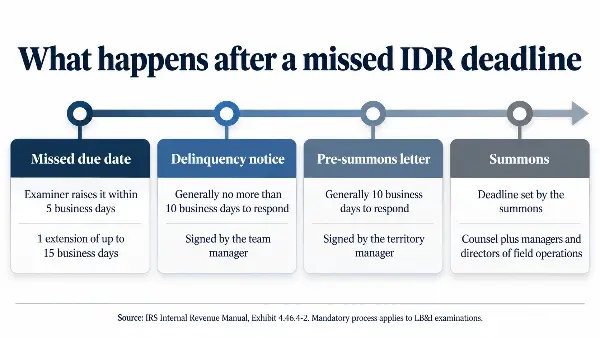
The IRS escalates, and in large-case examinations it escalates on a published schedule. The table below is the mandatory enforcement process from Exhibit 4.46.4-2 of the Internal Revenue Manual. No competing page publishes these numbers.
| Stage | What the IRS sends | Time you get | Who signs off |
|---|---|---|---|
| Missed due date | A conversation, not a letter | Examiner raises it within 5 business days; 1 extension of up to 15 business days is available | Examiner |
| Step 1 | Delinquency notice, issued within 10 days of the trigger | Generally no more than 10 business days | Team manager |
| Step 2 | Pre-summons letter, generally within 10 business days of the delinquency due date | Generally 10 business days | Territory manager, and the director of field operations for anything longer |
| Step 3 | Summons | Set by the summons itself | Counsel, with case and issue managers, territory managers and directors of field operations |
Read that with 2 caveats. This ladder is the LB&I process, so it isn’t the procedure governing a typical small business examination. And the manual carves listed transactions, transactions of interest, micro captive cases and syndicated conservation easement cases out of the mandatory process altogether.
What carries across every examination type is the endpoint. A summons is issued under IRC 7602 and it does compel production. The IRS can also summons third parties who hold your records, including your bank, which is how a document you declined to produce arrives anyway, with your refusal attached to it as context. Each round of this adds to how long it runs, and it ends in a proposed adjustment you then have to answer.

The IRS can’t make you create a document that doesn’t exist
This is the most useful rule on the page and almost nobody publishes it.
A Form 4564 will sometimes ask for something that was never a document. A reconciliation spreadsheet. A summary of deposits. A schedule tying your books to your return. If it doesn’t exist, you don’t have to build it, and the IRS can’t escalate its way into making you. The manual states it plainly: “A summons cannot require a witness to prepare or create documents, including tax returns, that do not currently exist.” That’s IRM 5.17.6.1.1(4), effective 28 November 2023.
Note the pin cite. Older articles, including the practitioner column this page was built from, cite paragraph (3). The text moved.
A document that exists but is hard to reach is a different matter. If your records are with a former bookkeeper, in storage, or on a system you no longer use, say so and ask for time. That’s an extension conversation, not a refusal. If the records are gone for good, that’s a different problem, and reconstructing what you can is usually better than producing nothing.

Michigan’s own records rule works the same way
A Michigan Treasury field audit runs on a similar logic with a harsher default, and no national firm writes about it.
Michigan’s field audit standards sit in the Administrative Code at R 205.2001 and following. The consequence rule is R 205.2009(9): “If an audited person does not have sufficient records or fails to provide records, the auditor shall determine the best information available and base the estimated tax liability on that information.” R 205.2005(5) adds that reasonable assurance “does not apply to an audit if the audited person does not have sufficient records or does not permit access to records.”
Read that as the state’s answer to the same question. Don’t produce records, and the auditor doesn’t stop. The auditor estimates, and you’re then arguing against a number somebody else built.
One limit worth stating, because the rules don’t say it. Michigan’s field audit standards set no notice period and no day count for producing records. Anyone telling you Michigan gives you a fixed window is reading something into the rules that isn’t there.
Before you send the IRS anything
Read the request against the scope of your own return first. The September 2025 guidance requires the examiner to name the particular activity and time period. If the request doesn’t, you have a reasonable question to ask rather than a box to fill.
Keep an exact copy of everything you send. When the examiner calls with a question 6 weeks later, you want to be looking at the same page they are. Number your response to match the request numbering on the form.
Send copies, not originals, unless the examiner specifically requires originals and you’ve agreed on how they come back.
Don’t volunteer material that wasn’t asked for. Extra documents invite extra issues, and the scope can widen as the audit goes.
And if there’s anything in the records you’d rather the IRS not see, stop before you send. That’s not a document-production question anymore. It’s a question about what kind of audit you’re actually in, and it should be answered by somebody who does this daily before the first page goes out the door. Representation during an examination changes who the examiner talks to and what gets produced.
We handle IRS examinations for individuals and businesses across Michigan, from offices in Brighton, Saginaw, Lansing and Jackson. If a Form 4564 arrived and you’re not sure how much of it you have to answer, book a free consultation or call 866-668-2953, and audit representation takes the response off your desk.
An information document request is the first real exchange in an audit, and what you send back sets the scope of everything after it. Get that one right.
FAQs
What is an IRS information document request?
An IRS information document request is a written list of records an examiner wants during an audit, issued on Form 4564 with a date for you to produce them. It’s a request, not an order, and it carries no direct penalty on its own. The current form is Rev. September 2006 and comes in 3 parts: your file copy, the copy you return with your reply, and the examiner’s copy.
Can the IRS ask for anything it wants on a Form 4564?
No. IRS interim guidance issued 15 September 2025 requires that a request “must be specific, and must avoid requesting more information than is essential to resolve the issues identified,” and that it “avoid requesting information that is already in the IRS’s possession.” The same guidance tells examiners to trim the generic template down to items relevant to the return being examined. If the request looks like a form letter, that’s a fair thing to raise with the examiner.
What happens if I ignore an information document request?
The IRS escalates. In large-case examinations the manual sets a published ladder: a delinquency notice signed by the team manager with generally no more than 10 business days to respond, then a pre-summons letter signed by the territory manager with generally another 10 business days, then a summons. Small business examinations don’t run that exact mandatory process, but the endpoint is the same, and a summons under IRC 7602 does compel production.
Can the IRS make me create a spreadsheet I don’t already have?
No. IRM 5.17.6.1.1(4) states that “a summons cannot require a witness to prepare or create documents, including tax returns, that do not currently exist.” If a request asks for a reconciliation, a summary or a schedule that was never a document, you can say it doesn’t exist. A document that does exist but is hard to reach is different, and that’s an extension conversation.
How long do I have to respond to an information document request?
Your deadline is the date in the “Information Due By” box, and IRS guidance requires that every Form 4564 carry one. Whether it’s negotiable depends on the examination. Large-case examinations run a formal process with a discussion period and 1 extension of up to 15 business days. Other examinations have no equivalent published ladder, so asking before the date passes matters more.
Does Michigan do the same thing during a state audit?
Michigan Treasury field audits work on similar logic with a different default. Michigan Administrative Code R 205.2009(9) says that if a taxpayer “does not have sufficient records or fails to provide records, the auditor shall determine the best information available and base the estimated tax liability on that information.” The state rules set no notice period or fixed day count for producing records.
Does getting a Form 4564 mean I’m in serious trouble?
Not by itself. A document request is routine in any examination that isn’t handled start to finish by mail, and most audits end in an adjustment or no change at all. What the form can tell you is where you are in the sequence, because the request number and the dates of previous requests are printed on it. A repeat request covering ground you thought you’d answered is worth taking seriously.

Bridgette Austin, Esq., EA, spent three years at Michigan State University’s Tax Clinic representing low-income taxpayers before the IRS – two as a student clinician, one as a post-graduate fellow. That work shaped her practice. A Bellaire, Michigan native with a Northern Michigan University bachelor’s and an MSU law degree, she now resolves IRS and State of Michigan tax debt cases at Austin & Larson.
Recent Comments