

Written By: Michael Vale
Reviewed By: Bridgette Austin, Esq., EA, Co-Founder and Tax Attorney
Last Reviewed: October 18, 2026
A qualified amended return is the one move that erases the IRS accuracy-related penalty instead of arguing about it later. File it before the IRS contacts you, and the extra tax you report gets treated as if it had been on the original return all along. No underpayment means no 20% penalty. File the identical form one day after the wrong kind of contact and it does nothing for you.
The rule sits in Treasury Regulation 1.6664-2(c)(3). It runs about a page. It is unforgiving, and most people never learn they missed the window until a penalty notice shows up.
We see the same pattern every filing season across our Michigan tax resolution offices. Someone finds unreported income from 3 years back, sits with it for 6 months deciding what to do, and by the time the 1040-X goes in the mail, the IRS has already sent a letter.

What is a qualified amended return?
It’s an amended return that the IRS treats as though it were your original, for penalty purposes only. You still owe the tax. You still owe interest. What disappears is the accuracy-related penalty on top.
A qualified amended return is an amended return filed after the original due date but before the IRS contacts you about that return, before a promoter or pass-through examination touches your transaction, before a John Doe summons covers your activity, and before the IRS announces a settlement initiative for a listed transaction you used.
The mechanism is worth understanding, because it explains why timing decides everything. The accuracy-related penalty is calculated on an “underpayment,” and an underpayment is the gap between the correct tax and the amount shown as tax on your return. Under Treasury Regulation 1.6664-2(c)(2), a qualified amended return folds the additional tax into that second number. Close the gap and there is nothing left to apply a percentage to.
This is different from asking for forgiveness. Reasonable cause relief under section 6664(c) asks the IRS to excuse a penalty it has already proposed. A qualified amended return means the penalty never exists.
What the 20% accuracy-related penalty costs you
The penalty runs 20% of the underpayment, stacked on top of the tax and the interest you already owe.
The IRS applies it in 2 main situations. Negligence, meaning you didn’t make a reasonable effort to follow the rules or you ignored a 1099 that showed up in the IRS computers. And substantial understatement, which the IRS defines as understating your tax by 10% of the tax required to be shown on your return or $5,000, whichever is greater. If you claimed the qualified business income deduction, that 10% drops to 5%.
Two things get missed. Interest does not go away, because a qualified amended return kills the penalty and nothing else, so the interest keeps running from the original due date. And you don’t have to be audited to get one. The IRS closed 497,621 tax return audits in FY2025, but accuracy-related penalties also arrive by mail, attached to computer-generated notices that no examiner ever touches. Both come up in almost every consult we run about common IRS penalties.
Why is the rate sometimes 40%?
Section 6662 doubles the 20% rate in 3 situations: gross valuation misstatements, transactions the IRS says lack economic substance that you did not disclose, and understatements tied to foreign financial assets you were required to report and didn’t. Offshore accounts and crypto held through foreign platforms land in that last bucket more often than people expect.
When does the qualified amended return window close?
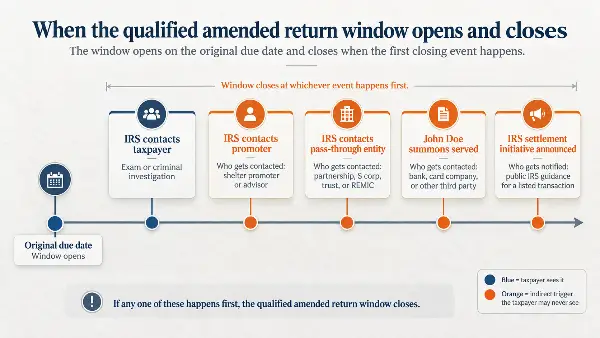
The window closes at the earliest of 5 events, and 4 of them can happen without anyone telling you.
| What closes the window | Who the IRS contacts | Would you know? |
|---|---|---|
| An examination of that return, including a criminal investigation | You | Yes |
| A section 6700 examination of a promoter whose deal you claimed a benefit from | The promoter | No |
| An examination of the return a pass-through item came from | Your partnership, S corporation or trust | Only if they tell you |
| A John Doe summons covering a group you belong to | Your bank, exchange or platform | No |
| A published settlement initiative for a listed transaction you used | Nobody, it runs in the Internal Revenue Bulletin | Only if you follow IRS guidance |
Three details in that first row decide most cases. The contact has to come from the IRS, so your accountant calling, your bank calling, or a business partner warning you does not start the clock. The contact has to concern that return, so a letter about your 2023 return should not close the window on 2021. And a criminal investigation counts as an examination, which catches people who assume the 2 are separate tracks.
Notice what is not on that list. Your accountant discovering the error is not on it. A friend getting audited is not on it. Deciding to fix it is not on it. None of the usual IRS audit triggers are on it either. The window stays open until one of those 5 things happens, and then it is shut.
Does a CP2000 notice close the window?
Treat it as closed. The label is debatable; the practical answer is not.
Here is the tension. A CP2000 comes out of the Automated Underreporter program, where IRS computers match your return against the 1099s and W-2s third parties filed. The IRS does not call that an audit. Its own Topic 652 describes a CP2000 as “a proposal to adjust your income, payments, credits, and/or deductions,” never an examination. Revenue Procedure 2005-32 goes further and lists adjustments from the information-return matching program among the contacts that are not examinations at all.
So a literal reading says the window might still be open. Do not bet a 20% penalty on it.
Revenue Procedure 2005-32 interprets section 7605(b), which governs when the IRS may reopen a closed examination. It was not written to interpret the qualified amended return rule, and no court has squarely decided whether a CP2000 counts as “first contact concerning any examination” under 1.6664-2(c)(3). That is an unresolved question, not a loophole.
More to the point, it stops mattering once the notice is in your hands. A CP2000 already proposes the additional tax, and the IRS says plainly that “certain penalties may also apply but may not be shown.” The accuracy-related penalty is usually one of them. At that stage you are no longer trying to prevent a penalty. You are arguing reasonable cause against one that has been proposed, which is a harder argument with a worse success rate.
Mailing a Form 1040-X in response is also the wrong move procedurally. If you have received one, our guide on how to respond to a CP2000 notice walks through the response process the IRS expects instead.

A summons to your bank can close your window first
This is the part that contradicts the advice you will read almost everywhere else: you can lose the window before you have any idea it started closing.
Johannes and Linda Lamprecht held an account at UBS. In 2008 the IRS served a John Doe summons on UBS covering US customers with undisclosed Swiss accounts. The Lamprechts were not named in it. In December 2010 they filed amended returns for 2006 and 2007 reporting the income. They argued those were qualified amended returns and the accuracy-related penalties should fall away.

What the court held
The Tax Court disagreed, and in April 2024 the D.C. Circuit affirmed. See Lamprecht v. Commissioner, No. 22-1308 (D.C. Cir., decided April 23, 2024). The summons covered the activity they had claimed a benefit from, so the window had shut in 2008, more than 2 years before they filed. The regulation says a summons closes the window for any return claiming a benefit from the type of activity the summons targets, whether or not the summons asks for that specific tax period, and whether or not you are named.
The court also held that the summons suspended the limitations period until it was formally withdrawn, which is how the IRS was still able to assess in 2015.
Read that sequence again. A document served on a foreign bank, naming someone else, closed a penalty window for 2 taxpayers who had no way to know. “Nobody has contacted me” is not the same thing as “my window is open.”
What changed in 2026
Two things closed windows this year that were open last year.
Digital asset reporting arrived. Under the IRS final regulations for broker reporting of digital asset sales, brokers reported gross proceeds from 2025 transactions on Form 1099-DA for the first time during the 2026 filing season, and basis reporting begins with 2026 transactions. Crypto that sat outside IRS visibility for years is now being matched against returns the same way a stock sale is. When that match fails, the notice that follows is a CP2000, and by then the window question is settled the wrong way.
The disclosure procedure for large taxpayers also changed. Revenue Procedure 2022-39 obsoleted the old Revenue Procedure 94-69 route and replaced it with Form 15307, filed within 30 days of an IRS written request, for examinations beginning after November 16, 2022. That form is treated as a qualified amended return. It applies only to taxpayers in the Large Corporate Compliance and Large Partnership Compliance programs, so it is not a path for a Michigan small business, but articles written before 2023 still point readers at a procedure that no longer exists.
There is no box to check, and no confirmation
Form 1040-X has no qualified amended return checkbox. The IRS will not tell you whether yours counted.
This surprises people more than any other part of the rule. You file the amended return the ordinary way, you pay the tax and the interest, and nothing in the process confirms your status. You learn the answer only if a penalty is later proposed and you have to argue about it, potentially years later. The filing mechanics are the easy part.
Which puts the burden on you to build the record at the time of filing. Date everything. Keep proof of what you knew and when you filed. Write a Part III explanation that states the correction and its source clearly and does not editorialize about why the error happened. In a fraud case that explanation is evidence, and a defensive one reads badly.
If your preparer made the error rather than you, the facts change and so does the explanation. We cover that separately in our post on what to do when a tax preparer makes a mistake.
Does a qualified amended return stop the fraud penalty?
No. The regulation carves fraud out, and this is where good intentions get people hurt.
Treasury Regulation 1.6664-2(c)(2) says the additional tax on a qualified amended return counts toward the amount shown on your return “except that such amount is not included if it relates to a fraudulent position on the original return.” So the 75% civil fraud penalty under section 6663 survives an otherwise perfect qualified amended return.
There is a second risk the rule creates and does not solve, and it turns on the line between avoidance and evasion. Your amended return shows the IRS exactly which items you changed and by how much. If those items look intentional rather than careless, you have handed over a map. The IRS carries the burden of proving fraud by clear and convincing evidence, which is a high bar, but the filing itself is where an examiner starts.
This is the line where the question stops being about filing. If the original return involved deliberate omissions rather than mistakes, a qualified amended return may be the wrong tool and the IRS Voluntary Disclosure Practice may be the right one. Have that conversation with a representative before anything gets filed, not after.
Michigan runs its own clock
Fixing the federal return does not close the Michigan file, and Michigan’s rule turns on the same trigger with a different agency.
Michigan Treasury operates a Taxpayer-Initiated Disclosure program that waives penalties for taxpayers who come forward on their own. Under Revenue Administrative Bulletin 2025-15, approved November 18, 2025, that relief requires that “there has been no previous contact by the Department.” A final letter of inquiry disqualifies you.
Same structure, 2 agencies, and the clocks run independently.
| Federal | Michigan | |
|---|---|---|
| What closes the window | IRS first contact about the return | Any previous contact from Michigan Treasury |
| Governing rule | Treasury Regulation 1.6664-2(c)(3) | Revenue Administrative Bulletin 2025-15 |
| Penalty if you miss it | 20% accuracy-related, 40% in some cases, 75% for fraud | 10% negligence, 25% intentional disregard, 100% fraud |
| What you file | Form 1040-X | MI-1040 with the amended box checked, plus Schedule AMD |
A federal audit letter does not close the Michigan window, and a Michigan inquiry does not close the federal one. You can be too late in Lansing and still in time with the IRS, or the reverse.
The Michigan penalties on the other side of that door are not small. Under the same bulletin, failure to file and failure to pay each run 5% for the first 2 months and 5% for every additional month, up to a 25% cap, on top of the discretionary penalties in the table above.

How do you amend a Michigan return?
Check the amended box on the Michigan state tax return and attach Schedule AMD, Form 5530. If you are claiming a refund, you have 4 years from the due date of the original return, which is a year longer than the federal refund window and catches people out in both directions.
What we do when someone calls before the IRS does
The first call we make is to the IRS account, not to the amended return.
The first step is your transcript
Before touching a 1040-X we pull the client’s IRS transcripts, because the transcript shows whether a contact has already been logged that the client has not received or has not recognized as a contact. An audit code or an AUR indicator on the account changes the whole strategy, and it is the same transcript pull we use to file back taxes when records are missing. It is a cheap check, and it is the one step that decides whether a qualified amended return is still on the table.
From there the sequence is the same every time. Confirm the window is open. Quantify the correction and the interest. Decide whether this is a qualified amended return case or a voluntary disclosure case, because the answer is not always the first one. File federal and Michigan together so one agency’s record does not contradict the other’s. Then document the filing date in a way that survives an argument 3 years from now.
Most of the people we help with this are self-employed or running a small business, where the problem sits in a Schedule C, a partnership K-1, or a year of tax return preparation done in a hurry. Getting current is its own project, so our tax compliance work usually runs alongside the amended return rather than after it.
If you have found a problem in a prior return and no letter has arrived, the window is probably still open, and it is worth 20 minutes to confirm that before it isn’t. Our audit representation team can pull your transcripts and tell you where you stand, and you can reach our offices for a no-cost review.
A qualified amended return is the cheapest fix available in tax controversy, and it has a deadline nobody announces.
FAQs
What is a qualified amended return?
A qualified amended return is an amended return filed after the original due date but before the IRS contacts you about that return or takes 4 other specific actions listed in Treasury Regulation 1.6664-2(c)(3). Filing one means the additional tax counts as if it had been reported originally, which removes the 20% accuracy-related penalty. You still owe the tax and the interest.
Can I file a qualified amended return after I get an IRS letter?
Generally no. Once the IRS contacts you about an examination of that return, the window is closed for that return and that year. A letter about one tax year should not close the window for a different year. If a CP2000 has already proposed the tax, your remaining argument is reasonable cause under section 6664(c), not qualified amended return status.
How much is the IRS accuracy-related penalty?
The penalty is 20% of the underpayment in most cases, on top of the tax and the interest. Section 6662 raises it to 40% for gross valuation misstatements, undisclosed transactions the IRS says lack economic substance, and understatements tied to unreported foreign financial assets.
Does filing an amended return trigger an audit?
Filing an amended return does not automatically trigger an audit. The IRS closed 497,621 tax return audits in all of FY2025, and most accuracy-related penalties are assessed without one. But an amended return showing a large jump in tax does get read, and it shows the IRS exactly what changed. That is a reason to file it correctly, not a reason to sit on it.
Does a qualified amended return protect me from the fraud penalty?
No. Treasury Regulation 1.6664-2(c)(2) excludes any amount that relates to a fraudulent position on the original return, so the 75% civil fraud penalty under section 6663 survives. If the original return involved deliberate omissions rather than errors, talk to a representative about the IRS Voluntary Disclosure Practice before filing anything.
Do I have to amend my Michigan return too?
Yes, when the federal change affects Michigan taxable income. Check the amended box on the MI-1040 and attach Schedule AMD, Form 5530. Michigan runs its own penalty clock: Revenue Administrative Bulletin 2025-15 waives penalties for taxpayers who disclose before any contact from Treasury, and Michigan’s fraud penalty is 100%.
How far back can I amend a tax return?
For a federal refund, generally 3 years from when you filed or 2 years from when you paid, whichever is later. For a Michigan refund, 4 years from the original due date. There is no deadline on filing an amended return that reports additional tax you owe, and the qualified amended return window is a separate clock that can close long before either of those deadlines.

Bridgette Austin, Esq., EA, spent three years at Michigan State University’s Tax Clinic representing low-income taxpayers before the IRS – two as a student clinician, one as a post-graduate fellow. That work shaped her practice. A Bellaire, Michigan native with a Northern Michigan University bachelor’s and an MSU law degree, she now resolves IRS and State of Michigan tax debt cases at Austin & Larson.
Recent Comments