

The home office deduction allows small business owners and self-employed individuals to write off a portion of their household expenses when they use part of their home regularly and exclusively for business. Qualifying expenses include mortgage interest, rent, utilities, insurance, repairs, and real estate taxes, among others.
Many small business owners either miss this deduction entirely or claim it incorrectly. Both mistakes are costly. Failing to claim a legitimate home office deduction means overpaying on your taxes. Claiming it improperly can trigger an IRS audit and result in additional tax debt, penalties, and interest. This guide covers which expenses qualify, how to calculate and claim the deduction using both available methods, and the most common errors that put taxpayers at risk.

Who Qualifies for the Home Office Deduction
The home office deduction is available to self-employed individuals and small business owners who use a portion of their home for business. You do not need to own your home to qualify. Renters can also claim this deduction.
To qualify, your home office must meet two IRS requirements.
Exclusive use. You must use the space you claim exclusively for business. A spare bedroom that doubles as a guest room does not qualify, even if you conduct business there daily. The IRS requires you to dedicate the area solely to your business activity.
Regular use. You must use the space on a consistent, ongoing basis for business purposes. Occasional or incidental use does not meet this standard.
There is one important exception. If you are an employee who works from home but your employer provides you with an office location, you generally cannot claim the home office deduction. The IRS designed this deduction for self-employed taxpayers and business owners, not remote employees with employer-provided workspaces.
Which Expenses You Can Deduct
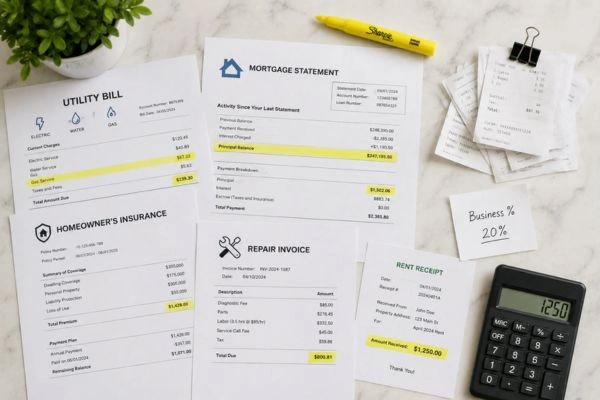
Small business owners with a qualifying home office can deduct a range of household expenses. These expenses fall into two categories.
Direct Expenses
Direct expenses are costs that apply only to your home office space. These are deductible at their full value because they benefit the business exclusively. Examples include painting or repairing the office room, installing dedicated business phone lines, or adding shelving used solely for business storage.
Indirect Expenses
Indirect expenses are costs that benefit your entire home, not just the office space. You can deduct a percentage of these expenses based on the portion of your home used for business. Common indirect expenses include the following.
Mortgage interest or rent paid for your home or apartment.
Real estate taxes assessed on your property.
Homeowner’s or renter’s insurance premiums.
Utilities such as electricity, gas, water, and internet service.
Repairs and maintenance that benefit the entire property, such as a new roof or furnace repair.
Other household expenses related to the general upkeep of the home.
To calculate your indirect expense deduction, divide the square footage of your home office by the total square footage of your home. The resulting percentage is applied to each indirect expense. For example, if your home office occupies 200 square feet of a 2,000 square foot home, you would deduct 10% of each qualifying indirect expense.
Two Methods for Claiming the Home Office Deduction
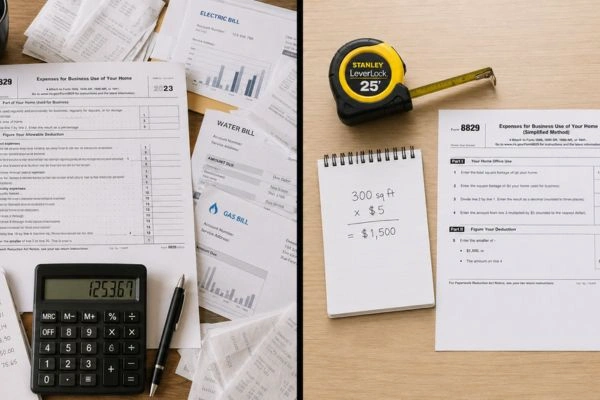
The IRS offers two methods for calculating your home office deduction. You can choose whichever method produces the better result for your situation, and you are allowed to switch between methods from year to year.
The Regular Method
The regular method involves calculating the actual expenses associated with your home office. You will report your deduction using IRS Form 8829, Expenses for Business Use of Your Home, which is attached to your Form 1040.
On Form 8829, you enter the total square footage of your home and the square footage of your office. The form calculates the business-use percentage, which is then applied to your indirect expenses. Direct expenses are entered at their full amount. The final deduction from line 35 of Form 8829 carries over to line 30 of Schedule C on your Form 1040.
The regular method typically produces a larger deduction for taxpayers who have significant mortgage interest, high utility costs, or substantial maintenance expenses. However, it requires detailed recordkeeping throughout the year.
The Simplified Method
The simplified method is designed for taxpayers who want a straightforward deduction with minimal recordkeeping. Instead of tracking every individual expense, you simply multiply the square footage of your qualifying home office by $5 per square foot.
The maximum area you can claim under the simplified method is 300 square feet, which results in a maximum deduction of $1,500.
For example, a self-employed individual who uses a 12-foot by 10-foot spare room exclusively for keeping business records and managing billing would claim 120 square feet. At $5 per square foot, the deduction would be $600.
You can use the simplified method even if it produces a larger deduction than the regular method. One additional advantage is that taxpayers who choose the simplified method can still claim the full amount of their property taxes as an itemized deduction on Schedule A. Because this method does not require Form 8829, you do not need to allocate any portion of those taxes to your business.
How to Decide Which Method to Use
If your home office expenses are significant, particularly mortgage interest, insurance, and utilities, the regular method will almost always produce a larger deduction. If your office is relatively small and your household expenses are modest, the simplified method saves time and paperwork while still providing a meaningful deduction.
We recommend that taxpayers calculate both methods in their first year of claiming the deduction to see which produces the better result. You can then make an informed choice going forward.
Common Mistakes That Trigger Audits
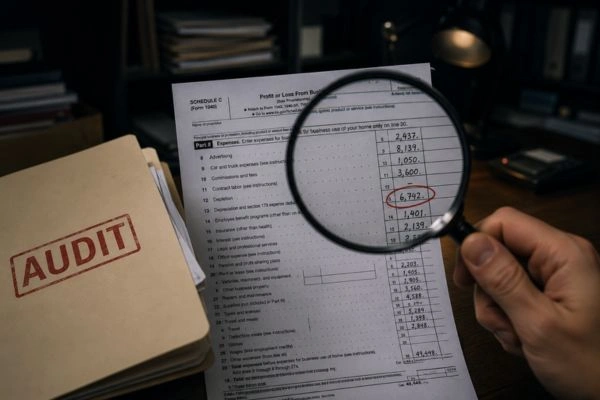
The home office deduction has a higher audit risk than many other deductions because of its potential for misuse. Avoiding these common errors will protect you if the IRS reviews your return.
Claiming the Full Expense Instead of the Business Portion
One of the most frequent errors is deducting the entire amount of an indirect expense rather than allocating the correct business-use percentage. If your home office represents 10% of your home’s total square footage, you can only deduct 10% of your mortgage interest, utilities, and other indirect costs. Claiming the full amount is a red flag that can prompt IRS scrutiny.
Using the Space for Both Personal and Business Purposes
The exclusive use requirement is strict. If your home office doubles as a playroom, guest bedroom, or personal hobby space, it does not qualify. The IRS expects the claimed area to be used only for business during the tax year. A desk in the corner of a shared living room will not meet this standard.
Inflating the Square Footage to Increase the Deduction
Some taxpayers exaggerate the size of their home office to increase the deduction. This is especially risky because the IRS can easily verify square footage through property records. Claiming a 500-square-foot office in a 1,200-square-foot home when the actual office is a 120-square-foot spare room will not withstand audit review.
Failing to Keep Proper Records and Documentation
The burden of proof for any deduction falls on the taxpayer. If the IRS audits your return and you cannot produce receipts, bills, bank statements, or other records supporting your claimed expenses, the deduction will be disallowed. Keep organized records of every expense you deduct throughout the year, and retain them for at least three years after filing.
Claiming a Home Office While Having an Employer-Provided Workspace
Employees who work from home but also have an office provided by their employer generally do not qualify for the home office deduction. The IRS designed this deduction for self-employed individuals and business owners. If your employer provides you with a workspace, the IRS will likely challenge a home office deduction on your personal return.
How the Home Office Deduction Reduces Your Tax Bill
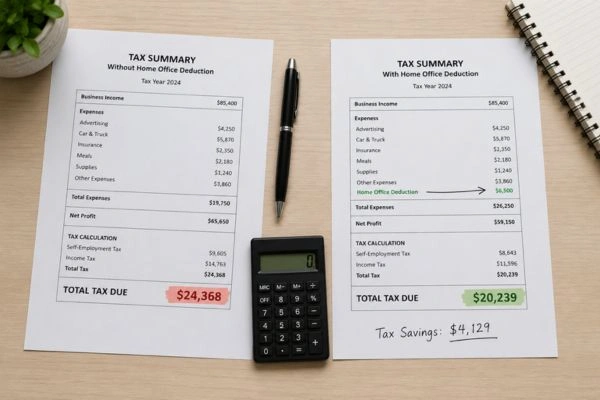
Understanding how the deduction flows through your return helps illustrate why it matters. The home office deduction directly reduces your net self-employment income on Schedule C. This means it lowers both your income tax and your self-employment tax (the 15.3% Social Security and Medicare tax that self-employed individuals pay).
For a self-employed taxpayer in the 22% federal income tax bracket, a $3,000 home office deduction would save approximately $660 in income tax plus an additional $459 in self-employment tax, for a total savings of over $1,100 on a single deduction. The higher your tax bracket and the larger your qualifying expenses, the more impactful this deduction becomes.
Frequently Asked Questions
Can I claim the home office deduction if I rent my home?
Yes. Renters can claim the home office deduction using either the regular method or the simplified method. Under the regular method, your monthly rent becomes an indirect expense that is deducted at your business-use percentage. Under the simplified method, the calculation is the same regardless of whether you own or rent.
What if I work from home and also have a separate office or business location?
You can still claim the home office deduction as long as you use the home office space regularly and exclusively for business. Having a second business location does not disqualify you. However, the IRS may look more closely at claims from taxpayers with multiple workspaces, so maintaining thorough documentation is especially important.
Does claiming a home office deduction increase my chances of being audited?
The home office deduction does carry a somewhat higher audit profile than other deductions, primarily because of its history of misuse. However, a properly documented and accurately calculated deduction should not cause concern. The key is meeting the exclusive and regular use requirements, keeping detailed records, and claiming only the amounts you can support. Taxpayers who follow these guidelines have no reason to avoid this legitimate deduction.
What happens to my home office deduction if I sell my home?
If you claimed the home office deduction using the regular method, a portion of any gain on the sale of your home may be subject to depreciation recapture. When you deduct actual expenses through Form 8829, the IRS requires you to depreciate the business-use portion of your home. Upon sale, that depreciation must be recaptured as taxable income. If you used the simplified method, depreciation recapture does not apply because the simplified method does not involve claiming depreciation.
Can I claim the home office deduction if I only work from home part of the year?
Yes, but your deduction will be prorated for the portion of the year you used the space for business. Under the regular method, you would only include expenses for the months the office was in use. Under the simplified method, you would multiply $5 per square foot by the number of months the office qualified, then divide by 12.

Bridgette Austin, Esq., EA, spent three years at Michigan State University’s Tax Clinic representing low-income taxpayers before the IRS – two as a student clinician, one as a post-graduate fellow. That work shaped her practice. A Bellaire, Michigan native with a Northern Michigan University bachelor’s and an MSU law degree, she now resolves IRS and State of Michigan tax debt cases at Austin & Larson.
Recent Comments