

Written By: Michael Vale
Reviewed By: Bridgette Austin, Esq., EA, Co-Founder and Tax Attorney
Last Reviewed: October 11, 2026
Michigan gives your accountant a real privilege. Federal law gives you almost none.
Under Michigan’s own statute, a CPA can’t be made to turn over your file, and the statute says so in those words. Move that same file into an IRS criminal case or a federal court on a federal question, and the protection is gone. Federal courts have never recognized a general accountant-client privilege. There’s a narrow federal one written into the tax code, and it stops at the criminal line.
So accountant client privilege in Michigan isn’t one answer. It’s 5 answers, depending on which room you’re standing in. Below is the map, the statute quoted, and the 1 sentence in Michigan law that lets your own accountant walk your records to law enforcement without telling you first.
Accountant client privilege is the protection that keeps communications between a taxpayer and an accountant out of evidence. No general federal version exists. Michigan creates one by statute at MCL 339.732, covering information from a CPA’s professional service. A separate, narrower federal privilege under IRC 7525 covers tax advice in noncriminal tax matters only.

What is accountant client privilege?
It’s a rule that stops your accountant from being forced to reveal what you told them. Unlike attorney-client privilege, it isn’t automatic, and in most of the country it barely exists.
The rule comes from 2 places, and they don’t agree with each other. State law creates privileges for licensed accountants in some states and not others. Federal law creates a separate, much narrower one for tax advice, written into the tax code at 26 U.S.C. 7525.
Neither one behaves like attorney-client privilege. Attorney-client privilege follows you into a criminal case. Accountant privilege doesn’t, which is why the difference between a tax attorney and a CPA stops being an academic question the moment your exposure changes.
Michigan happens to be a state that gives its CPAs a strong one. That’s good news with a sharp edge on it, and the next 2 sections are about the edge.
Does Michigan have its own accountant client privilege?
Yes, and it’s written in stronger language than most people expect. Accountant client privilege in Michigan comes from MCL 339.732, part of the Occupational Code.
Subsection (1) reads: “Except by written permission of the client or the heir, successor, or personal representative of the client to whom the information pertains, a licensee, or a person employed by a licensee, shall not disclose or divulge and shall not be required to disclose or divulge information relative to and in connection with an examination or audit of, or report on, books, records, or accounts that the licensee or a person employed by the licensee was employed to make.”
Read the phrase “shall not be required to disclose or divulge.” That’s the part that matters. The section goes on: “the information derived from or as the result of professional service rendered by a certified public accountant is confidential and privileged.”
Notice what isn’t in the statute. There’s no written exception for a subpoena. No exception for a court order. The permission that opens the file is yours, in writing, and the statute names 3 situations where a CPA may disclose anyway. None of the 3 is “somebody served a subpoena.”
That’s broader than the federal privilege by a wide margin. It’s also the reason Michigan taxpayers get comfortable, and comfort is what creates the problem in the next section.
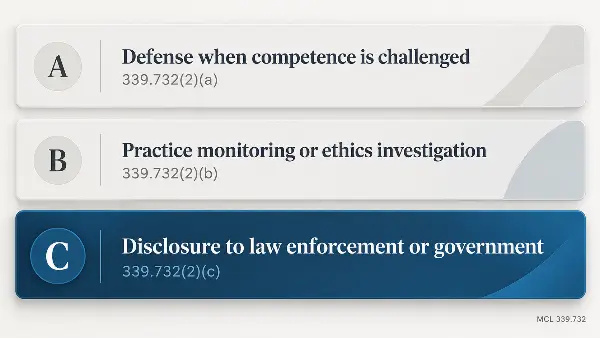
The line in Michigan’s statute that can cost you the case
Subsection (2)(c) lets your accountant report you on their own. This is the piece no national article on this topic covers, and it’s the single most useful thing a Michigan business owner can know about their CPA.
The text permits a licensee to disclose otherwise privileged information “to appropriate law enforcement or governmental agencies when the licensee, or person employed by the licensee, has knowledge that forms a reasonable basis to believe that a client has committed a violation of federal or state law or a local governmental ordinance.”
Put the 2 subsections side by side and Michigan law says something uncomfortable. Your accountant can’t be compelled to talk. Your accountant is allowed to volunteer. The privilege protects you from the government’s subpoena, not from your accountant’s conscience.
Here are all 3 exceptions the statute writes in:
| Subsection | What it permits | Why it matters to you |
|---|---|---|
| (2)(a) | A CPA whose “professional competence has been challenged in a court of law or before an administrative agency” may use your confidential information to defend themselves | If your accountant ends up a defendant in a matter touching your return, your file becomes their defense exhibit |
| (2)(b) | Disclosure in practice monitoring and ethics investigations conducted by another licensed CPA | Narrow, and the statute keeps the information confidential in those hands |
| (2)(c) | Disclosure to law enforcement or government agencies on a reasonable basis to believe the client broke federal or state law, or a local ordinance | The one that matters. No court order needed, no notice to you required |
So the honest version is this. Michigan’s statute is a shield against being forced. It is not a promise of loyalty. That distinction matters most for Michigan business owners, because a business file carries years of bookkeeping decisions a CPA formed opinions about.
The 5 rooms, and what your accountant can be made to say in each
Privilege is decided by the forum, not by the relationship. Same accountant, same file, 5 different answers.
| The room | What rule governs | Can your accountant be compelled? |
|---|---|---|
| Michigan state court, civil matter | MCL 339.732 | No, not without your written permission. The statute has no subpoena exception |
| Federal court, civil case decided under Michigan law | FRE 501 sends the court to state privilege law | No. The Michigan privilege travels with the claim |
| Federal court, federal question | FRE 501 sends the court to federal common law | Yes. Couch holds there is no federal accountant privilege |
| IRS civil examination | IRC 7525 | Only tax advice is protected. Everything else is reachable |
| Criminal tax matter | Nothing applies | Yes. IRC 7525 shuts off by its own terms, and no common law privilege exists |
Federal Rule of Evidence 501 is what splits rooms 2 and 3. It says that “in a civil case, state law governs privilege regarding a claim or defense for which state law supplies the rule of decision.” A diversity case applying Michigan law brings the Michigan privilege with it. A federal question case does not.
One case decides the other 3 rooms. In Couch v. United States, 409 U.S. 322 (1973), the Supreme Court dealt with an IRS summons served on a taxpayer’s accountant for the business records she’d handed him to prepare her returns. The Court stated plainly that “no confidential accountant-client privilege exists under federal law, and no state-created privilege has been recognized in federal cases.”
That decision is from 1973 and it hasn’t moved. Which brings up the point at the middle of this article: Michigan’s privilege being broader than the federal one is not a comfort. It’s the trap. A Michigan taxpayer builds years of habits around a protection that evaporates the moment the matter crosses into federal criminal territory, and nobody tells them the room changed.

Can the IRS make your accountant hand over your file?
In a criminal matter, yes. In a civil examination, mostly yes, with a narrow exception for genuine tax advice.
The IRS doesn’t need to persuade your accountant. It issues a summons, and Couch settled that no federal accountant privilege stands in the way. Your written permission, which Michigan law requires, isn’t part of the federal analysis at all.
Workpapers go too. In United States v. Arthur Young & Co., 465 U.S. 805 (1984), the Supreme Court held that “the tax accrual workpapers are not protected from disclosure” under the IRS summons authority. The Court’s reasoning explains why accountants will never get what lawyers have. An independent auditor, the Court wrote, “assumes a public responsibility transcending any employment relationship with the client,” and owes “ultimate allegiance to the corporation’s creditors and stockholders, as well as to investing public.”
A lawyer is your advocate. An auditor, in the Supreme Court’s framing, is not. That’s structural, and no engagement letter changes it.
Practically, this means the notes your accountant wrote about why a deduction looked thin, the email where you explained the cash deposits, the file memo about the year the books were a mess: all of it is reachable. If you’ve ever wondered what an IRS examination can pull in, the answer includes your accountant’s working file.
What the federal privilege under IRC 7525 covers in 2026
Not much, and it’s built to be narrow. IRC 7525(a)(1) extends “the same common law protections of confidentiality which apply to a communication between a taxpayer and an attorney” to a communication between a taxpayer and a “federally authorized tax practitioner.”
Then it takes most of that back, in 4 limits, all written into the statute:
- Tax advice only. Subsection (a)(3)(B) defines tax advice as advice on a matter “within the scope of the individual’s authority to practice” before the IRS. Bookkeeping isn’t advice. Business planning isn’t advice. Compiling your financials isn’t advice.
- Noncriminal matters only. Subsection (a)(2) allows the privilege in “any noncriminal tax matter before the Internal Revenue Service” and “any noncriminal tax proceeding in Federal court brought by or against the United States.” Those 2 rooms, and no others.
- Federal only. State court is not on that list. Neither is a divorce, a partnership dispute, or a creditor suit.
- No tax shelters. Subsection (b) strips protection from written communications with any person “in connection with the promotion of the direct or indirect participation of the person in any tax shelter,” using the definition in IRC 6662(d)(2)(C)(ii).
The practitioner who holds this privilege has to be federally authorized under 31 U.S.C. 330, which covers CPAs, enrolled agents, and attorneys practicing before the IRS. An unenrolled preparer has nothing to assert.
Here’s the part that catches people. A conversation protected today, during a civil audit, loses protection retroactively if the case turns criminal. The statute doesn’t grandfather anything. It stops applying, and everything you said while it applied is still in the file.

Does the privilege cover your tax return?
No, and the reason sits in the statute’s own wording. IRC 7525 protects tax advice. Preparing and filing a return is compliance work, not advice, so the privilege doesn’t reach it. That holds whether the work is done by a solo preparer or a firm offering full tax return preparation.
The return itself was never confidential in any useful sense either. You signed it, and you sent it to the government. There’s no secret to protect.
That extends further than most people expect. The documents you handed over so the return could be prepared, the schedules built from them, the reconciliations: courts have generally treated that whole category as outside the privilege, and Arthur Young confirms that even an accountant’s own analytical workpapers come out under a summons.
If your position depends on documents, the answer isn’t privilege. It’s keeping records that support the return in the first place.
What a Kovel arrangement does, and what it doesn’t
A Kovel arrangement puts an accountant inside attorney-client privilege by making the accountant the lawyer’s helper instead of yours. The attorney engages the accountant, the accountant reports to the attorney, and the work exists so the attorney can advise you.
The sequence is the whole thing. Hire the accountant yourself and bring a lawyer in afterward, and the protection generally isn’t there, because the accountant wasn’t working for the lawyer when the conversations happened.
It also isn’t a laundering mechanism, and the paperwork on its own doesn’t create the privilege. Courts look at what the work was for, not what the engagement letter calls it.

What to settle before the next conversation with your accountant
You don’t need to distrust your CPA. You need to know which room you’re in before you talk.
- Ask whether anything on a filed return is wrong. Not wrong in the IRS’s opinion. Wrong in yours. If the answer is yes, the privilege analysis above is the only part of this page that matters to you. Where it’s a mistake rather than a choice, the penalties look different and so does the strategy.
- Assume federal exposure means no privilege. Not reduced privilege. None. Plan the conversation on that basis and you’ll never be surprised.
- Put the sensitive question to a lawyer first. Attorney-client privilege survives a criminal matter. The tax code privilege doesn’t. Order decides what stays protected, and you only get to choose the order once.
- Don’t ask your accountant to fix it quietly. You’re handing a person who may later be a witness a detailed account of what you knew and when.
- Keep the file intact. Michigan’s statute protects information, not evidence you decided to tidy up. Destroying records creates a separate and much worse problem.
- If a notice has already arrived, what you do in the first days shapes the rest of it more than anything you do later.
Most people reading this are fine. Their return is defensible and their accountant is good. The people who aren’t fine usually find out after the conversation that created the problem, not before.
Talk to someone before you talk to your accountant
Austin & Larson Tax Resolution represents Michigan taxpayers in IRS examinations from offices in Brighton, Saginaw, Lansing and Jackson. If there’s something on a filed return you’d rather nobody found, the order of your next 2 phone calls decides how much of it stays protected. Call (866) 668-2953 or ask about audit representation to get a read on where you stand. The first consultation is free.
This article is general information about Michigan and federal tax procedure. It isn’t legal advice, and reading it doesn’t create an attorney-client relationship.
FAQs
Is there accountant client privilege in Michigan?
Yes. MCL 339.732 provides that a licensed CPA “shall not disclose or divulge and shall not be required to disclose or divulge” information from an examination, audit, or report they were employed to make, without the client’s written permission. The statute contains no exception for a subpoena or court order. It does contain 3 other exceptions, including one allowing voluntary disclosure to law enforcement.
Can my accountant be forced to testify against me?
In a Michigan state court civil matter, no, not without your written permission. In a federal criminal case, yes. The Supreme Court held in Couch v. United States, 409 U.S. 322 (1973), that no confidential accountant-client privilege exists under federal law and that no state-created privilege has been recognized in federal cases.
Can my accountant report me to the IRS?
In Michigan, yes. MCL 339.732(2)(c) permits a CPA to disclose privileged information to law enforcement or government agencies when they have “knowledge that forms a reasonable basis to believe that a client has committed a violation of federal or state law.” The statute protects you from being compelled. It does not stop a voluntary report.
Does accountant client privilege apply in a criminal case?
No. IRC 7525 limits the federal tax practitioner privilege to noncriminal tax matters before the IRS and noncriminal federal court proceedings. Once a matter is criminal, the statute stops applying, including to conversations that happened while it did apply.
Is what I tell my CPA about my tax return confidential?
Not under federal law. IRC 7525 covers tax advice, and return preparation is compliance work rather than advice. United States v. Arthur Young & Co., 465 U.S. 805 (1984), held that even an accountant’s own tax accrual workpapers are not protected from an IRS summons.
What is the difference between attorney-client privilege and accountant client privilege?
Attorney-client privilege applies in civil and criminal matters, in state and federal court. Accountant privilege depends on the forum. Michigan’s version is strong in state court and absent in a federal criminal case, and the federal tax version at IRC 7525 covers only tax advice in noncriminal tax matters.
Does accountant client privilege apply in a divorce?
Michigan’s MCL 339.732 is not limited to tax matters, so a Michigan CPA still can’t be required to disclose without written permission. The federal privilege at IRC 7525 gives you nothing here, because it reaches only noncriminal tax matters before the IRS and in federal court. A divorce is neither.

Bridgette Austin, Esq., EA, spent three years at Michigan State University’s Tax Clinic representing low-income taxpayers before the IRS – two as a student clinician, one as a post-graduate fellow. That work shaped her practice. A Bellaire, Michigan native with a Northern Michigan University bachelor’s and an MSU law degree, she now resolves IRS and State of Michigan tax debt cases at Austin & Larson.
Recent Comments