

Written By: Michael Vale
Reviewed By: Bridgette Austin, Esq., EA, Co-Founder and Tax Attorney
Last Reviewed: July 2, 2026
Owe the IRS more than you can pay right now? Two programs come up more than any others: an offer in compromise and an installment agreement. An offer in compromise settles your tax debt for less than the full amount, and the IRS turns down most applications. An installment agreement spreads the full balance into monthly payments, and almost everyone who applies gets approved.
Which one fits comes down to one question the IRS asks about you, and it has nothing to do with how badly you want a discount. If the agency thinks it can eventually collect the whole balance from your income and assets, you get a payment plan. If it can’t, you may qualify to settle for less. This guide covers how each works, what they cost in 2026, your real odds, and how to tell which side of that line you land on. It won’t get into disputing whether you owe the tax at all (a separate process called doubt as to liability), bankruptcy, or innocent spouse relief, because those solve a different problem.
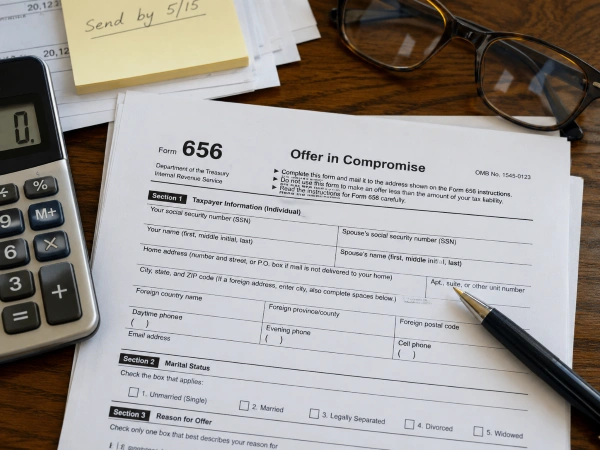
What Is an Offer in Compromise?
An offer in compromise is an IRS program that lets a qualifying taxpayer settle a federal tax debt for less than the full amount owed. You propose an amount, prove you can’t pay the full balance, and if the IRS agrees the offer reflects the most it can collect, the rest is forgiven.
That last clause is where offers live or die. The IRS doesn’t care that you’d like to pay less. It runs a number called your reasonable collection potential, or RCP, and your offer has to meet or beat it. I’ve sat across from people who owed $80,000 and assumed a big settlement was automatic. It isn’t. The question is never how much you owe. It’s how much the IRS believes it can collect from you before the debt expires.
Who qualifies, and how the IRS does the math
You qualify when your reasonable collection potential comes in below what you owe. RCP is a formula, not a feeling, and you can run it yourself before spending a dollar.
Add up the equity in everything you own, including your home, vehicles, bank accounts, and retirement. Then take your monthly income, subtract the living expenses the IRS allows, and multiply what’s left. Paying within five months means you multiply by 12. Needing six to 24 months means you multiply by 24. Add the asset number to the income number and that’s roughly your minimum offer. Say you have $10,000 of equity in a paid-off car and $400 left each month after allowed expenses. On a five-month payoff, your floor is about $10,000 plus $4,800, so $14,800. No story talks the IRS down to $5,000 on that file.
The squeeze is in those allowed expenses. The IRS uses national and local standards, not your actual budget. If your rent runs above the local cap, the agency often won’t count the overage, which lifts the income side of the formula and pushes your offer higher. That single mechanic is the most common reason offers come back rejected. An offer in compromise is one of several tax relief services the IRS makes available, but it’s also the strictest.
What an offer in compromise actually costs
Filing costs $205 up front in 2026, plus a deposit of 20% of your offer if you pay by lump sum. Both are non-refundable. If the IRS says no, that money is applied to your debt, not returned to you.
Income at or below 250% of the federal poverty line (roughly the high $30,000s for a single filer in 2026) gets both the fee and the deposit waived. The thresholds by family size sit in the Form 656 booklet. Then there’s the cost almost nobody budgets for, which is professional help. It isn’t cheap, and that’s the part that stings. Plenty of people pay for representation, watch the offer get rejected, and walk away out the fee with the full debt still on the books and interest that never stopped.
Your real odds in 2026
Most offers get rejected, and that’s the data talking, not pessimism. The IRS accepted about one in five offers in 2024, roughly 7,200 of the 33,600 submitted. Across the past decade the rate has averaged closer to one in three, and it topped 40% in 2023 before dropping hard. Lately the line points down.
The reason isn’t cruelty. A lot of people file offers they were never going to win, usually after an ad promised pennies on the dollar. When the RCP math doesn’t support the number, the answer is no. Realistic applications with clean documentation do far better than that headline rate suggests. The weak ones drag the average down.

What Is an IRS Installment Agreement?
An installment agreement is a payment plan that lets you pay your full IRS balance over time in monthly amounts. Interest and penalties keep running until it’s cleared, but the penalty rate drops and the IRS stops levying your accounts once the plan is active. Most people who apply get approved.
If the offer is the lottery ticket, the installment agreement is the paycheck. The IRS set up more than three million new agreements in its 2025 fiscal year. Hold that next to a few thousand accepted offers. For most people who owe, this is what resolution actually looks like.
The 2025 Simple Payment Plan overhaul
In 2025 the IRS scrapped its old individual payment-plan track and replaced it with the Simple Payment Plan, then opened the door to businesses. Owe $50,000 or less with all returns filed, and you can usually set one up online in about ten minutes with no financial disclosure.
The terms are worth knowing. At $50,000 or less you get up to ten years, no Collection Information Statement. Owe under $100,000 and need only a short runway, and a short-term plan gives you up to 180 days with no setup fee at all. The long-term setup fee runs from $22 (online with direct debit) to $178 (phone or mail without it). Low-income filers pay nothing or get reimbursed.
A plan doesn’t freeze the meter. Interest keeps compounding, around 7% in early 2026 and dropping to 6% in April, and the failure-to-pay penalty keeps adding up, though it falls from 0.5% to 0.25% a month once you’re active. On a $20,000 balance, carrying it for years can tack on a few thousand dollars. Pay faster than the minimum when you can. One detail the online tool won’t flag loudly is that balances between $25,000 and $50,000 require direct debit, or the IRS files a Notice of Federal Tax Lien. Set it on autopay and you usually dodge the lien.
The middle option most taxpayers never hear about
There’s a third path between settling and paying in full, and almost no one mentions it. It’s the partial payment installment agreement. You make monthly payments, but not enough to cover the whole debt before the IRS’s ten-year collection clock runs out. Whatever’s left when the clock expires goes away.
People hear ‘offer in compromise’ and assume it’s the only way to pay less than the full amount. That’s not quite right. A partial payment plan can land you in a similar spot without the brutal upfront math, especially when your income is low now but the debt is old and the collection deadline is close. It still needs a full financial disclosure, so it isn’t effort-free. For the right file, though, it’s the quiet winner. There’s also Currently Not Collectible status, where the IRS agrees you can’t pay anything at the moment and pauses collection. The balance doesn’t shrink and interest keeps running, but the pressure stops, which buys time for someone between jobs. These aren’t the only tax resolution options worth weighing, but they’re the ones that surface most when an offer in compromise isn’t the fit.

Offer in Compromise vs. Installment Agreement: The Key Differences
Side by side, the contrast is plain. One cuts the debt and is hard to get. The other keeps the debt and is easy to get.
| Feature | Offer in Compromise | Installment Agreement (Simple Payment Plan) |
|---|---|---|
| Amount you pay | Less than the full balance, if accepted | Full balance, plus interest and penalties |
| Who gets approved | About 1 in 5 in 2024; strict RCP test | Almost everyone who qualifies and has filed returns |
| Upfront cost | $205 fee plus 20% deposit (waived for low income) | $0 to $178 setup (waived or reduced for low income) |
| Financial disclosure | Full (Form 433-A, OIC) | None for balances of $50,000 or less |
| Time to a decision | 6 to 24 months | Minutes to a few weeks online |
| If you default | Full original debt returns, plus interest | IRS can resume levies and liens |
| Best fit | Low income and assets, no realistic path to pay in full | Steady income, able to pay over time |
Read the decision-time row twice. An offer can tie up your file for a year or more while interest stacks. A payment plan can be live the same afternoon.
Which Option Is Right for You?
Choose an offer in compromise only when your assets and income are too low to ever clear the balance and you can prove it on paper. Choose an installment agreement when you can pay over time and just need the IRS to stop circling. For most people who owe, the second one is the honest answer, and it’s the plan we set up most often at Austin & Larson Tax Resolution.
A few patterns from the files we work across Brighton, Saginaw, Lansing, and Jackson. Someone on a fixed income who owes $40,000, rents, drives a paid-off 2014 car, and has $800 in the bank is an offer candidate. Someone earning $90,000 who fell behind during one rough year and owes $28,000 is a payment plan, almost every time, because the IRS can see that income and knows it will get paid.
When chasing an offer in compromise is the costliest mistake
Most people who walk in asking about an offer in compromise should not file one. The marketing won’t say that, so I will. The settle-for-pennies ads sell the exception as if it were the rule.
The most expensive mistake I see isn’t a weak offer. It’s paying a firm to chase an offer when the facts point to a Simple Payment Plan, Currently Not Collectible status, or simply running out the collection clock. The offer gets rejected, the fee is gone, the debt is bigger, and the taxpayer is right back where they started. The economics of how tax relief companies charge are worth understanding before you sign anything.
Can you file an offer yourself? Sure. The IRS has a free pre-qualifier tool and the forms are public, and for a clean situation it’s doable. The catch is that incomplete financials are the top reason offers get returned with no decision, and you don’t always get a second swing. A professional won’t guarantee acceptance. What they buy you is a package that doesn’t get bounced on a technicality.
What about your Michigan tax debt?
A federal offer in compromise does nothing for money you owe the State of Michigan. People learn that the hard way. The IRS and the Michigan Department of Treasury keep entirely separate books, and settling one leaves the other untouched.
Michigan runs its own program through the state Treasury, created under Public Act 240 of 2014, with its own form (Form 5181) and its own review. You apply on one of three grounds: you can’t pay, you don’t actually owe it, or the IRS already accepted your federal offer. That last ground can get Michigan to match the federal percentage on your individual income tax, but it won’t touch sales tax, since the IRS never had a sales tax to compromise. Michigan also wants a deposit of the greater of $100 or 20% of your offer. Running a Michigan offer in compromise alongside a federal one is its own project, and getting both right usually means working them together rather than one at a time.
If you take one thing from all this, take this. The choice between an offer in compromise and a payment plan isn’t about which sounds better. It’s about what the IRS can prove it’s able to collect from you. Run your reasonable collection potential first. If it lands well under what you owe, an offer in compromise might be the real thing and worth doing carefully. If it doesn’t, a payment plan stops the bleeding faster and cheaper than a rejected offer ever will. When you’re ready to match the right option to your actual numbers, it’s worth talking it through with people who handle both every week.
FAQs
What is the offer in compromise acceptance rate in 2026?
The IRS accepted about one in five offers in 2024, roughly 7,200 of the 33,600 submitted, and the ten-year average sits closer to one in three. Acceptance swings year to year based on IRS enforcement and the quality of applications. Offers with realistic numbers and complete documentation perform far better than the headline rate.
How long does an offer in compromise take?
Most offers take six to 24 months to get a decision, and timelines have stretched as submissions rose. By law, if the IRS does not decide within 24 months of receiving your offer, it is treated as accepted. Collection activity is paused during the review.
Can I file an offer in compromise myself?
Yes. The IRS publishes the forms and a free pre-qualifier tool, and a straightforward case is doable on your own. The risk is that incomplete or inaccurate financial statements are the leading reason offers get returned without review, and a returned offer can cost you the non-refundable $205 fee plus your deposit.
What happens if my offer in compromise is rejected?
You have 30 days to appeal a rejection using Form 13711, and you can also resubmit with stronger documentation or switch to a payment plan or Currently Not Collectible status. The $205 application fee and your 20% deposit are non-refundable and get applied to your tax balance.
Does a payment plan or an offer stop IRS collection?
Generally yes. The IRS pauses levies and other active collection while an offer is under review and while an installment agreement is in good standing. A federal tax lien may still be filed, and a lien is different from a levy.

Bridgette Austin, Esq., EA, spent three years at Michigan State University’s Tax Clinic representing low-income taxpayers before the IRS – two as a student clinician, one as a post-graduate fellow. That work shaped her practice. A Bellaire, Michigan native with a Northern Michigan University bachelor’s and an MSU law degree, she now resolves IRS and State of Michigan tax debt cases at Austin & Larson.
Recent Comments