

In 2024, the IRS received 33,591 Offer in Compromise applications and accepted 7,199 of them. That’s a 21% approval rate, down from 42% just one year earlier. Most rejections don’t come from complicated financial situations or unusual tax problems. They come from incomplete paperwork, miscalculated offer amounts, and compliance failures that could’ve been avoided with proper preparation.
An Offer in Compromise lets you settle your IRS tax debt for less than the full balance owed. It’s one of the most powerful tools in the IRS’s debt resolution toolbox, but it’s also one of the most misunderstood. Late-night TV ads promise you can settle “for pennies on the dollar.” The reality is more specific than that: the IRS runs a formula, and your offer needs to meet or exceed that number.
Here’s what the program actually requires, how the IRS decides your minimum offer amount, and where most applicants go wrong.

How the IRS Calculates What They’ll Accept
The IRS doesn’t negotiate your offer like a car dealership. They calculate it.
Every OIC runs through a formula called Reasonable Collection Potential (RCP). This is the IRS’s estimate of the maximum amount they believe they can collect from you before the 10-year collection statute expires. The formula looks like this:
RCP = Net realizable equity in assets + (monthly disposable income x 12 or 24)
You multiply by 12 if you’re submitting a lump-sum offer (paid within 5 months of acceptance). You multiply by 24 for a periodic payment offer (paid over 6 to 24 months). Your offer amount must meet or exceed your RCP. Anything below that number gets rejected unless you can document special circumstances like significant medical costs or other hardships.
Net realizable equity means the IRS takes the quick-sale value of your assets (roughly 80% of fair market value), then subtracts any loans or liens against them. Monthly disposable income is your gross income minus allowable living expenses as defined by the IRS’s Collection Financial Standards, which were last updated on April 21, 2025.
This is where most applicants make their first mistake. They guess at an offer amount based on what feels reasonable to them. The IRS doesn’t care what feels reasonable. They care about whether the math on Form 433-A (OIC) supports the number on Form 656.
What You Need Before You Can Apply
The IRS won’t even process your offer if you don’t meet these compliance requirements first:
All required tax returns must be filed. The IRS typically requires at least the past six years of returns, including both individual and business returns if applicable. If you have unfiled years, the OIC package gets returned unopened.
Current-year estimated tax payments or W-4 withholdings must be up to date. If you’re a wage earner, your withholding needs to reflect the correct amount. If you’re self-employed, your quarterly estimates need to be current. The IRS checks this as a compliance indicator before they’ll review your financials.
You can’t be in an active bankruptcy proceeding. The IRS will not consider an OIC while a bankruptcy case is open.
If you have employees, federal tax deposits for the current quarter and the past two quarters must be current.
Miss any one of these, and the IRS returns your entire package, including your $205 application fee.
The Application Package, Form by Form
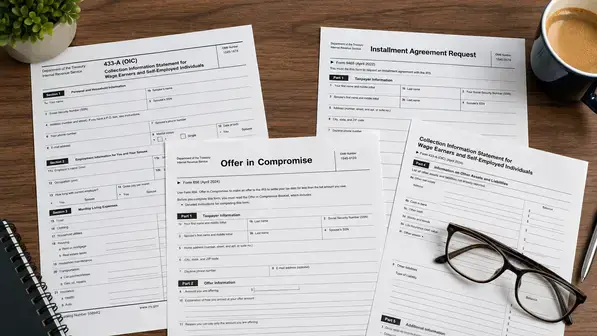
The IRS updated Form 656 and Form 433-A (OIC) most recently in April 2026 (Rev. 4-2026). Submitting an older version will get your package returned without review. Here’s what goes into a complete OIC submission:
Form 433-A (OIC) is the financial disclosure for individuals and sole proprietors. This is the form where you report every bank account, investment, piece of real property, vehicle, and asset you own. You’ll also detail your monthly income and expenses. The IRS uses this form to calculate your RCP. Three months of personal bank statements are required, six months for business accounts. Pay stubs, loan statements, retirement account balances, and documentation for any digital assets you hold all need to be included.
Form 433-B (OIC) is the business equivalent for corporations, partnerships, and LLCs.
Form 656 is the actual offer itself. This is where you identify which tax years and types you’re compromising, state your offer amount, and choose your payment terms.
The $205 application fee is non-refundable regardless of outcome. Low-income taxpayers (at or below 250% of the federal poverty guideline) can qualify for a waiver of both the fee and the initial payment by certifying on Form 656.
For a lump-sum offer, you’ll include 20% of the total offer amount with your application. For a periodic payment offer, you include the first monthly payment and continue paying monthly while the IRS reviews your case.
One missing form, one unsigned page, one outdated bank statement, and the IRS sends the whole package back. Incomplete financials are one of the most common reasons offers get returned without any chance to appeal.

What Happens After You File
Once the IRS receives a complete package, they place a hold on your account. Collection activity stops while your offer is under review. A few things to know about this period:
The IRS has up to two years to make a decision. If they don’t act within that window, your offer is automatically accepted. In practice, most decisions come within 6 to 12 months, though complex cases can take longer.
You’ll receive a letter with an estimated contact date. Don’t expect to hear anything for several months after that letter arrives. When an Offer Specialist is assigned, they’ll contact you to discuss your financials. They may ask for additional documentation or clarification on specific line items.
The IRS may also file a Notice of Federal Tax Lien during the review period. This protects the government’s interest in your assets while the offer is pending.
Three outcomes are possible. The IRS accepts your original offer. They counter with a higher amount. Or they reject the offer entirely.
If Your Offer Gets Rejected
A rejection letter gives you 30 days to file an appeal. This deadline is firm. Miss it and you lose your right to appeal entirely.
When you appeal, your case gets reassigned to a new, independent Appeals Officer who wasn’t involved in the original review. They’ll look at the original submission, any new financial information you provide with the appeal, and the Offer Specialist’s analysis. The Appeals Officer can accept your offer, recommend a different amount, or uphold the rejection.
If an OIC isn’t viable for your situation, other options exist. An installment agreement lets you pay the full balance over time. Currently Not Collectible (CNC) status pauses collection if you can’t cover basic living expenses. A partial payment installment agreement allows smaller monthly payments when full payment isn’t realistic. Each program has different eligibility requirements and consequences, and the right choice depends entirely on your specific financial picture.
The Five-Year Compliance Covenant
This is the part most taxpayers don’t fully understand until it’s too late.
Once the IRS accepts your Offer in Compromise, you enter a five-year compliance period. During those five years, you must file every required return on time and pay every dollar of tax owed in full. No late filings. No new balances due. No missed estimated payments.
If you default on any of these requirements, the IRS can revoke the accepted offer. When that happens, the full original tax balance comes back, plus all the interest and penalties that accumulated from the original assessment date. Payments you made under the OIC get credited against the reinstated balance, but you’re right back where you started, often owing more than before.
This is why proper planning before you submit an offer matters as much as the offer itself. You need to know that your income, withholding, and estimated payments are structured so you won’t create a new balance during those five years.

Why Professional Representation Changes the Outcome
The IRS doesn’t negotiate. They calculate. That distinction matters.
When your bank statements don’t match the monthly budget on Form 433-A, the IRS disallows expenses and increases your RCP, meaning your minimum offer goes up. When you claim expenses above the IRS’s allowable standards without proper justification, those expenses get stripped out. When assets are left off the disclosure, it destroys your credibility with the Offer Specialist and can result in an outright rejection.
At Austin & Larson Tax Resolution, our team prepares OIC packages with the same financial analysis methodology the IRS uses internally. We calculate your RCP before we submit, so the offer amount is built on the same math the Offer Specialist will run. We verify compliance across all open tax years, ensure current-year obligations are squared away, and structure the supporting documentation so the reviewer can verify every number without delays or requests for additional information.
Managing Attorney Emily Rienau leads our tax resolution practice and works directly with clients throughout the OIC process, from initial financial analysis through acceptance or appeal.
If you owe the IRS more than $10,000 and want to know whether an Offer in Compromise is realistic for your situation, contact our office at 866-668-2953. We’ll review your tax account transcripts and financial picture to determine whether the OIC program, an installment agreement, or another resolution path makes the most sense for you.
Disclaimer: Austin & Larson Tax Resolution has prepared this content for informational purposes only. It is not intended to provide, and should not be relied on for, tax, legal, or accounting advice. To get advice regarding your specific tax situation, contact our office at 866-668-2953.
FAQs
How much does it cost to apply for an Offer in Compromise?
The IRS charges a non-refundable $205 application fee. You’ll also need to include an initial payment: 20% of your total offer for a lump-sum offer, or the first monthly payment for a periodic payment offer. Low-income taxpayers at or below 250% of the federal poverty guideline can qualify for a waiver of both the fee and the initial payment.
What is the IRS acceptance rate for Offers in Compromise?
The acceptance rate dropped to 21% in 2024, down from 42% in 2023 and a historical average around 30-40%. Most rejections result from incomplete applications, compliance failures, or offer amounts below the IRS’s calculated Reasonable Collection Potential.
How long does the OIC process take?
Most decisions come within 6 to 12 months. The IRS has a maximum of two years to make a determination. If they don’t act within that two-year window, the offer is automatically accepted.
Can I file an Offer in Compromise online?
Yes. As of 2025, the IRS allows you to check eligibility, make payments, and file your OIC through your Individual Online Account at IRS.gov. Paper filing by mail is still an option.
What happens to IRS collections while my offer is being reviewed?
The IRS suspends most collection activity while your offer is pending. However, they may file a Notice of Federal Tax Lien to protect the government’s interest in your assets during the review period.
What forms do I need to file an Offer in Compromise?
Individuals need Form 656 (the offer itself) and Form 433-A (OIC) (financial disclosure) along with all required supporting documentation. Businesses also need Form 433-B (OIC). All forms are included in IRS Form 656-B, the Offer in Compromise Booklet. The most current revision is April 2026.
What happens if I default on my OIC after acceptance?
The IRS can revoke the accepted offer and reinstate your full original tax liability, including all accrued interest and penalties from the original assessment date. Payments made under the OIC are credited to the reinstated balance.

Bridgette Austin, Esq., EA, spent three years at Michigan State University’s Tax Clinic representing low-income taxpayers before the IRS – two as a student clinician, one as a post-graduate fellow. That work shaped her practice. A Bellaire, Michigan native with a Northern Michigan University bachelor’s and an MSU law degree, she now resolves IRS and State of Michigan tax debt cases at Austin & Larson.
Recent Comments