

Written By: Michael Vale
Reviewed By: Bridgette Austin, Esq., EA, Co-Founder and Tax Attorney
Last Reviewed: September 20, 2026
No. Hiring a tax attorney does not make the IRS suspicious, and it does not move your file into a different pile. The IRS picks returns 2 ways. It compares your return against norms for similar returns. It also pulls in returns tied to other taxpayers already under audit. Who signs your paperwork is not part of that math. Representation is a right the agency publishes in writing. The ninth entry in the Taxpayer Bill of Rights reads: “Taxpayers have the right to retain an authorized representative of their choice to represent them in their dealings with the IRS.”
The real risk for Michigan taxpayers runs the other direction. Most people assume one signature covers every agency collecting from them. It does not, and the gap is where cases stall.
Hiring a tax attorney does not make the IRS suspicious. The IRS picks returns by statistical formula and by links to other audited returns. Who represents you is not part of it. Filing a power of attorney is a routine step. The Taxpayer Bill of Rights guarantees your right to a representative of your choice.

Where the “lawyering up” fear comes from
The fear is borrowed from criminal television, not from tax procedure. In a police interview, asking for a lawyer changes the tone of the room. In a tax matter, it changes the mailing address. That is the plain reason you should not talk to the IRS without a tax lawyer once a case is open.
The 2 systems are built for different jobs. A revenue officer is measured on closing collection cases. An auditor is measured on closing audits. Neither has a field on their file for how you feel about lawyers. What they have is a deadline and a list of documents they still need.
There is a second reason the fear does not hold up. Filing a power of attorney is not a confession. It is a form. The IRS takes in these forms constantly and keeps them in a central file. The agency’s own audit guidance lists “a right to representation, by oneself or an authorized representative” among the rights you keep during an audit.

Does hiring a tax attorney trigger an audit?
No. Representation plays no part in how returns get picked. The IRS explains selection in 2 ways: “sometimes returns are selected based solely on a statistical formula. We compare your tax return against ‘norms’ for similar returns,” and returns are also selected “when they involve issues or transactions with other taxpayers, such as business partners or investors, whose returns were selected for audit.”
Both of those happen to the return. Both happen before you hire anyone. That is worth keeping in mind when you read about who gets audited in 2026. By the time most people search this question, the notice is already in their hands. The pick was made months earlier.
What does correlate with scrutiny is what is on the return itself. If you want the honest list, the 4 red flags that trigger an IRS audit are all return-level items. None of them is a signature block.
Audit coverage also sits at the top of the income scale. IRS compliance presence data for tax year 2021 puts the audit rate at 6.6% for people reporting total positive income of $10 million or more. It falls to 3.9% in the $5 million to $10 million band, and 0.9% from $1 million to $5 million. Income drives coverage. Counsel does not.
What Form 2848 does, and what it does not do
Form 2848, Power of Attorney and Declaration of Representative, is the document that puts a representative in front of the IRS. Once it is on file, they can speak, file and negotiate for you, within the scope you granted.
3 limits are worth knowing before you sign one.
It is scoped. A 2848 covers the tax types, forms and periods you list on it. A power of attorney filed for a 2023 income tax exam does not cover a 2024 payroll matter. When a new year or a new tax type enters the case, the authorization has to grow with it.
Your notices do not follow it by default. This one surprises people. The IRS instructions for Form 2848 say that to have your representative receive copies of what the IRS sends you, “you must check the box provided under the representative’s name and address.” The same instructions cap it: “You may not designate more than two representatives on Form 2848 (or designees on a Form 8821) to receive copies of notices and communications sent to you by the IRS for the same matter(s).” Miss the box and your representative is working your case without seeing your mail.
It is federal. This is the part that catches people, and it is the subject of the next 2 sections.
Can the IRS still contact you directly?
Yes, in set circumstances. The popular framing of an attorney as a wall is wrong. The protection is real, and it is narrower than most articles claim.
Internal Revenue Code section 7521 sets the rules. If you tell an IRS officer during an interview that you want to consult a representative, that officer “shall suspend such interview,” and the statute says that holds “regardless of whether the taxpayer may have answered one or more questions.” Separately, an IRS officer “may not require a taxpayer to accompany the representative in the absence of an administrative summons issued to the taxpayer.”
The same section also contains the exception. An IRS officer, “with the consent of the immediate supervisor,” may contact you directly to say the officer believes your representative is responsible for “unreasonable delay or hindrance” of the examination or investigation. The Internal Revenue Manual sets the path for that bypass at section 4.11.55.2.1.3, which requires repeated requests for non-privileged information and then supervisor permission.
Put together, the rule is simple. Your representative is the default the IRS has to work through. The agency cannot drag you to a meeting without a summons. And going around your representative takes a written reason and a manager’s sign-off.
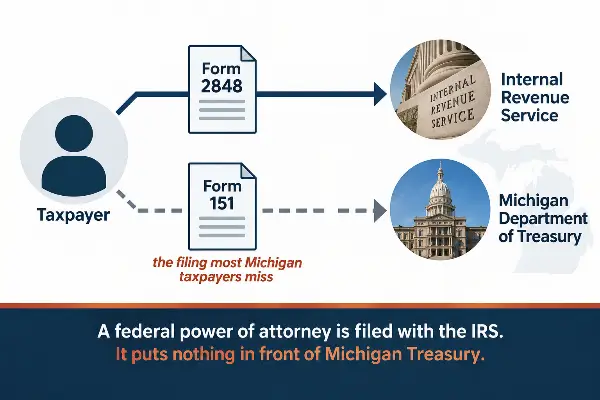
Why your federal power of attorney does nothing at Michigan Treasury
A signed Form 2848 authorizes your representative before the Internal Revenue Service. It does not authorize anyone at the Michigan Department of Treasury, because it was never filed there.
Michigan runs its own system. MCL 205.28(1)(f) bars Treasury staff from sharing your private tax information with anyone but you or your authorized representative. A state rule then sets how that representative gets named. Under Mich Admin Code R 205.1006b, “a taxpayer’s written authorization should be provided by filing a properly completed Michigan Department of Treasury Form 151.”
The rule does allow other options. Another written document works if it carries everything the rule asks for. That list runs long: your name, address, phone and ID number, your representative’s details, the dates covered, what they may and may not do, then a signature, printed name, title and date. A court order for guardianship or conservatorship can work too.
Notice what is missing from that list. Michigan’s rule names no federal form. The practical problem comes before the legal one. A Form 2848 goes to the IRS. Signing one puts nothing in front of Treasury. If you owe both agencies, and many Michigan taxpayers do, half your representation can be missing while you think it is handled.
This is the same split that shows up elsewhere in Michigan tax work, where a federal offer in compromise does nothing for a state balance. 2 collectors, 2 sets of paperwork.
Here is how the 2 forms line up.
| Question | IRS Form 2848 | Michigan Form 151 |
|---|---|---|
| Which agency does it cover? | Internal Revenue Service | Michigan Department of Treasury |
| Where do you file it? | With the IRS | With Michigan Treasury |
| What rule sits behind it? | IRC 7521 sets the interview and direct-contact rules | Mich Admin Code R 205.1006b names the form, and MCL 205.28(1)(f) restricts disclosure |
| Does your representative get your notices automatically? | No. You must check the box under the representative’s name | No. Treasury provides confidential information on request only |
| How many representatives can receive your information? | No more than 2 for the same matter | No more than 1 official representative for a single dispute |
| What does it not cover? | Anything before Michigan Treasury | Anything before the IRS |
Read the fourth row twice. Neither form puts your mail in your representative’s hands on its own. Both take a deliberate step, and most people take neither.
What to file with Michigan Treasury in 2026
File Form 151, Authorized Representative Declaration. Michigan Treasury’s own guidance directs taxpayers who want to authorize a representative to “complete and file a form 151, Authorized Representative Declaration.”
3 details on that form change how a case runs, and none of them are obvious from the outside.
Treasury does not push information to your representative. The form says confidential information “will only be provided upon request; Treasury will not automatically send confidential information to your representative.” Your representative has to ask. So a Michigan case can look quiet while notices keep arriving only at your address.
It runs until you stop it. The form’s instructions say: “if no start date is indicated the authorization is effective as of the date this form is signed. If no expiration date is indicated the authorization is effective until revoked.” Leaving the end date blank is a choice, not a slip. Make it on purpose.
One representative per dispute. Michigan’s guidance is explicit that a taxpayer “shall not designate more than 1 official representative under this section for a single dispute.”
Working an IRS balance and a Michigan balance at the same time means 2 filings, not 1. A Michigan tax lawyer files both as a matter of course. IRS representation runs on Form 2848. Michigan representation runs on Form 151.

Is an attorney better than a CPA or an enrolled agent here?
For getting in front of the IRS, no. Attorneys, CPAs and enrolled agents all hold unlimited practice rights before the IRS under Circular 230. All 3 file the same Form 2848. On the question this article asks, the credential changes nothing. None of the 3 makes the IRS suspicious.
Where the credential does change something is confidentiality. Attorney-client privilege comes from common law. The privilege covering CPAs and enrolled agents comes from Internal Revenue Code section 7525. The statute limits it on its face to “any noncriminal tax matter before the Internal Revenue Service” and “any noncriminal tax proceeding in Federal court brought by or against the United States.” Section 7525(b) also strips it from written messages tied to promoting a tax shelter.
2 cautions, because this gets oversold both ways. Attorney-client privilege is not absolute either. It does not cover messages made to further an ongoing or future crime or fraud. And when an attorney prepares a return, courts usually treat that as preparer work, not legal advice. If confidentiality is driving your choice, read the difference between a tax attorney and a CPA before the first conversation, not after.

When does representation change the outcome?
Some cases are simple enough to handle alone. A small math-error notice, with the paperwork already in your file, is one.
The picture changes when the case moves from a computer notice to a person. Once a revenue officer is assigned, the IRS has stepped it up, and revenue officer representation becomes worth pricing out. From there, what to do when a revenue officer contacts you is a process question with deadlines attached. Revenue officers ask for Form 9297, Summary of Taxpayer Contact. They also ask for a Collection Information Statement, Form 433-A for people or Form 433-B for businesses. Those forms open your finances to the agency. What you put on them shapes what the IRS decides you can pay.
Unfiled returns are the other common step up, and getting the missing years filed is the whole of tax compliance work. How many years of back returns the IRS can require sets the size of the cleanup. Missing returns can block a payment plan outright. They also open the door to a Substitute for Return, which the IRS prepares for you under section 6020(b). The agency builds it without the deductions and credits you never claimed.
Payroll tax cases sit in their own class. Unpaid trust fund taxes reach the people who controlled the money, personally.
None of that says a lawyer scares the IRS. It says these cases have rules, deadlines and forms. Audit representation is mostly about getting those right the first time.
One number to stop repeating
A lot of tax firm websites say the tax code runs more than 70,000 pages. It does not. A firm that repeats it is quoting a publisher’s catalogue, not the law.
The Tax Foundation, working from Government Printing Office figures, puts the Internal Revenue Code itself at 2,652 pages. That is roughly 1 million words. Add the Treasury regulations and you reach about 9,000 pages and 4 million words. The 70,000-page number belongs to a commercial set, CCH’s Standard Federal Tax Reporter. It bundles the statutes, the regulations and the case notes together.
The true version makes the same point without the stretch. The law is long enough that process, not persuasion, decides most cases.
What to do next
Hiring a tax attorney is a filed form, not an admission. The IRS treats it as paperwork. The thing worth checking is not whether it looks bad. It is whether your representation covers every agency collecting from you.
If you owe the IRS, the Michigan Department of Treasury, or both, Austin & Larson Tax Resolution can check where your paperwork stands and what is missing. Call (866) 668-2953 to set up a consultation with our tax attorneys and IRS enrolled agents.
FAQs
Does hiring a tax attorney make the IRS suspicious?
No. The IRS picks returns by comparing them against norms for similar returns. It also pulls in returns tied to other audited taxpayers. Who represents you is not part of it. The Taxpayer Bill of Rights lists the right to a representative as the ninth of 10 taxpayer rights.
Does hiring a tax attorney trigger an audit?
No. The pick happens at the return level, usually months before anyone hires a lawyer. IRS compliance presence data for tax year 2021 shows audit coverage tracks income, not representation. The rate for the highest income band was more than 7 times the rate for the band below it.
Can the IRS contact me directly after I file a power of attorney?
Only in set circumstances. Under IRC 7521(c), an IRS officer may contact you directly, with an immediate supervisor’s consent, to say the officer believes your representative is causing unreasonable delay or hindrance. The Internal Revenue Manual sets that bypass path at 4.11.55.2.1.3.
Does IRS Form 2848 cover my Michigan state tax problem?
No. Form 2848 is filed with the IRS and covers the IRS. Michigan’s rule, R 205.1006b, says a taxpayer’s written authorization “should be provided by filing a properly completed Michigan Department of Treasury Form 151.”
What is Michigan Form 151?
Form 151, Authorized Representative Declaration, is the form that lets someone act for you before the Michigan Department of Treasury. MCL 205.28(1)(f) stops Treasury from sharing your private tax information with anyone but you or an authorized representative.
Will Michigan Treasury send my representative copies of my notices?
Not automatically. Form 151 states that confidential information “will only be provided upon request; Treasury will not automatically send confidential information to your representative.” Your representative has to request it. The IRS works the same way. Its Form 2848 instructions say you must check a box under the representative’s name for them to receive copies of your notices.
Is a tax attorney better than a CPA or enrolled agent for IRS representation?
All 3 hold unlimited practice rights before the IRS under Circular 230, and all 3 file the same Form 2848. The difference is confidentiality. The privilege under IRC 7525 applies only in noncriminal tax matters before the IRS and noncriminal federal tax cases. Attorney-client privilege is broader, though not absolute.

Bridgette Austin, Esq., EA, spent three years at Michigan State University’s Tax Clinic representing low-income taxpayers before the IRS – two as a student clinician, one as a post-graduate fellow. That work shaped her practice. A Bellaire, Michigan native with a Northern Michigan University bachelor’s and an MSU law degree, she now resolves IRS and State of Michigan tax debt cases at Austin & Larson.
Recent Comments