
Written By: Michael Vale
Reviewed By: Bridgette Austin, Esq., EA, Co-Founder and Tax Attorney
Last Reviewed: May 16, 2026
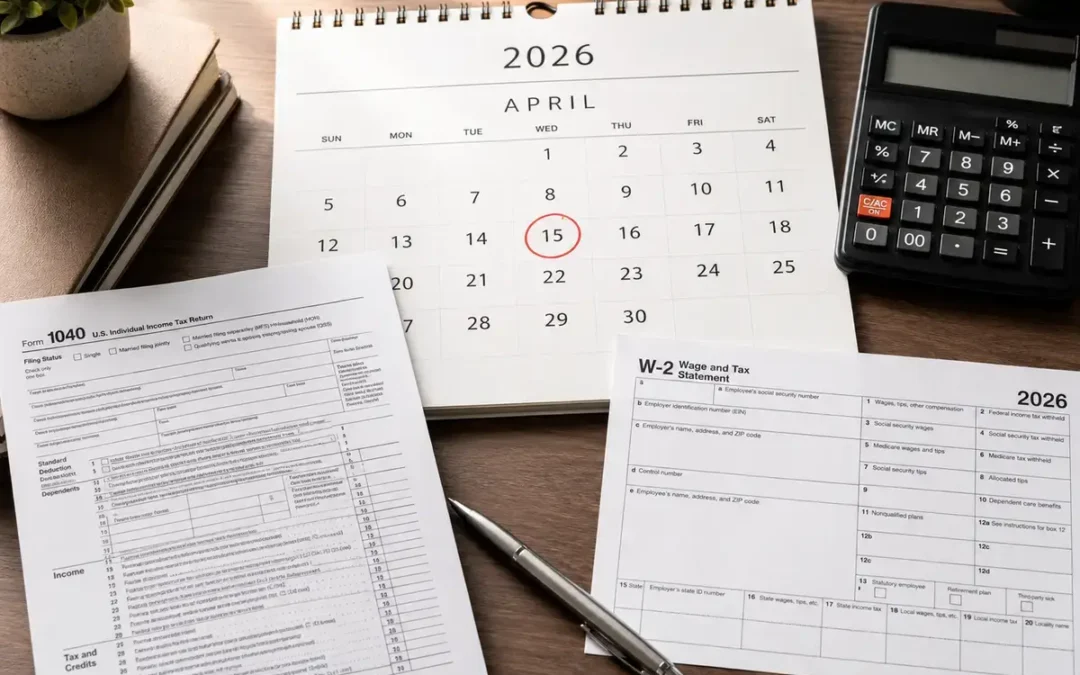
The default advice on when to file taxes: file as early as possible, get your refund faster. That advice is right about 60% of the time. The other 40% should wait, sometimes weeks. Calendar-year filers have until April 15, 2026 to submit federal returns. Filers with simple W-2 income and complete paperwork should file by mid-February. Filers expecting K-1s or corrected 1099s should not.
Filing taxes in 2026 means submitting a federal return between late January, when the IRS opens filing season, and April 15. The IRS expects roughly 164 million individual returns. Most refunds land within 21 days via direct deposit. Through late March 2026, the average refund sat at $3,521, up 11.1% year over year.
This season also runs against the first full year of the One Big Beautiful Bill Act, signed July 4, 2025. New deductions cover tips up to $25,000, qualified overtime up to $12,500 single or $25,000 joint, plus $6,000 extra for taxpayers 65 and older. The IRS released Schedule 1-A to handle the changes, adding roughly 10-15% more complexity per return per 2026 AICPA practitioner reports. Rushing before you understand what you can claim costs real money.

When to File Taxes for the 2026 Season
For most filers with W-2 income and a standard deduction, mid-February is the sweet spot. The IRS opens filing season in late January. By early February, your W-2 and most 1099s have arrived. Wait past March and you’re competing for preparer availability in an industry already short on labor. CPA exam candidates are down more than 30% since 2016, and time-to-fill for CPA roles in 2026 averages 73 days.
Here’s what most articles won’t tell you: filing early prevents fraud. The IRS processed roughly 294,000 identity-theft returns in fiscal year 2023, and resolution averages about 22 months. When a fraudster files a fake return in your name first, your legitimate return gets kicked into manual review. The fix is to file before the bad actors do. The right professional tax preparation help catches the documentation issues that slow refunds down.
In the cases we’ve worked through, identity theft locks were the longest refund delays we saw. Six months wasn’t unusual. Clients who filed by mid-February rarely ran into it. That’s not a coincidence.
What If Your 1099 Forms Have Errors?
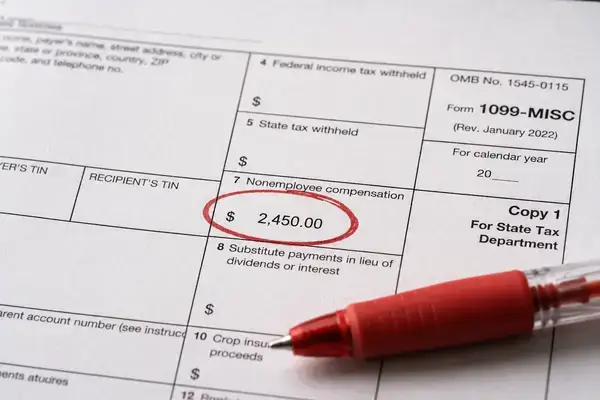
Companies must send 1099s and W-2s by January 31, and they file copies with the IRS the same day. If the numbers on your return don’t match IRS records, you’ll get a CP2000 notice. It usually shows up six to eighteen months after filing, with interest stacked on top of the original difference.
When a 1099 looks wrong, contact the payer for a corrected version. If you’ve already filed using bad numbers, you’ll need Form 1040-X to amend. Amendments take the IRS 4 to 6 months, and a CPA or EA charges $200 to $500 to prepare one per the 2025 NATP Fee Study. That’s $500-plus out of pocket for not waiting two extra weeks. Avoidable amendments rank among the top issues we handle through our tax resolution services every year.
What About Schedule K-1s and Other Late Documents?
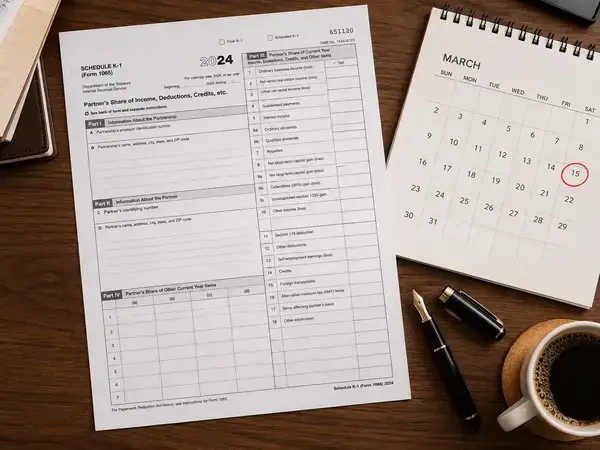
If you own a piece of a partnership, S-corp, or pass-through entity, your Schedule K-1 isn’t due until March 15. That’s almost two months past the W-2 deadline. Filing before the K-1 arrives means estimating numbers, then amending, then paying for the amendment, then waiting months for clearance.
Three groups should almost never file in January:
1. Partnership and S-corp owners waiting on K-1s
2. Investors with brokerage activity (revised 1099-B forms are common in March)
3. Self-employed taxpayers still reconciling Q4 invoices and expenses
If you own the underlying business and prepare your own K-1, you can move faster. Most filers can’t. Filing deadlines for individual and pass-through returns are set in 26 U.S.C. § 6072, and those dates matter more than most taxpayers realize.
How Filing Early Affects Retirement Contributions
This is the angle most articles miss. The IRS lets you contribute to a traditional IRA or HSA for the previous tax year up until the April filing deadline. The 2026 IRA limits are $7,000 standard and $8,000 for filers age 50 or older. HSA contribution caps sit at $4,400 for self-only coverage and $8,750 for family coverage.
Drafting a return early tells you two things: whether you qualify based on income, and how much cap space remains. Pull a draft together in February so you have eight weeks of paychecks to fund it.
When Is Waiting to File the Smarter Move?
Filing late and filing on time with an extension are not the same thing. The first one costs you. The second one doesn’t, as long as you pay any estimated balance by April 15.
Form 4868 buys you six extra months to file, pushing the deadline to October 15, 2026. The catch: extension of time to file is not extension of time to pay. Any tax owed is still due April 15. Miss the payment and you’re hit with the failure-to-pay penalty of 0.5% per month, plus interest. The failure-to-file penalty is 10x worse at 5% per month, which is why filing an extension always beats not filing. Ongoing tax compliance is what keeps these penalties from stacking up year after year.
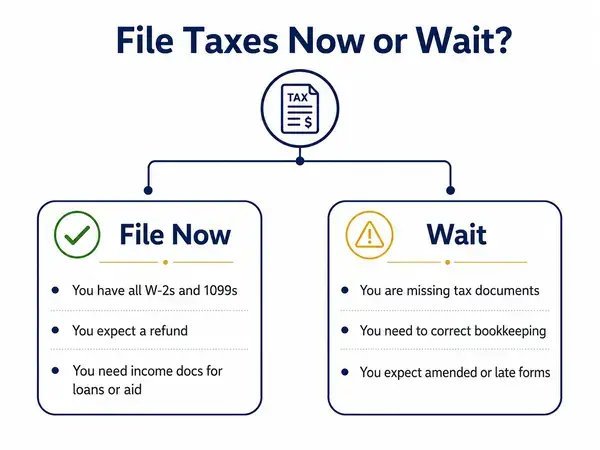
Waiting makes sense when:
• You’re owed a refund but missing documents (no penalty applies)
• You expect a K-1, revised 1099, or other late paperwork
• The cost of amending will exceed the benefit of filing fast
• You owe money and need time to arrange payment
If you owe and can’t pay, file anyway. Then talk to a tax resolution professional about IRS payment options. The penalty for not filing is far worse than the penalty for filing without paying.
File Now or Wait: A Quick Decision Guide
| Your Situation | Recommendation | Why |
| W-2 income, standard deduction, all forms in | File mid-February | Faster refund and fraud protection |
| Brokerage activity or investments | Wait until early March | Revised 1099-Bs are common |
| K-1 from a partnership or S-corp | Wait until late March | K-1s aren’t due until March 15 |
| Self-employed with Q4 invoices outstanding | Wait until reconciled | Avoid amendment costs |
| Expecting to owe and can’t pay | File anyway, set up payment plan | Failure-to-file is 10x worse |
Deciding when to file taxes in 2026 isn’t a calendar question. It’s a paperwork question. If forms are in and your situation is clean, file in February. If anything is missing, wait. The cost of filing too early is almost always higher than waiting two more weeks.
FAQs
When can I start filing my 2026 tax return?
The IRS typically opens filing season in late January 2026. Most W-2s and 1099s are required to be mailed by January 31, so realistically, mid-February is when most filers have all forms in hand. The full filing window runs through April 15, 2026.
What is the deadline to file taxes in 2026?
The federal tax deadline for calendar-year filers is April 15, 2026. If you need more time, Form 4868 grants a six-month extension to October 15, 2026. The extension applies to filing only, not to paying. Any tax owed is still due April 15.
Should I file my taxes early or wait?
File early if you have simple W-2 income, a standard deduction, and all required forms. Wait if you’re expecting a Schedule K-1, may receive a revised 1099, or have complex self-employment activity. The choice depends on document completeness more than calendar pressure.
What happens if I file my taxes early and then get a corrected form?
You’ll need to file Form 1040-X to amend your return. IRS amendment processing takes 4 to 6 months on average, and professional preparation costs $200 to $500. For most filers, waiting two extra weeks costs less than amending.
Does filing early help with identity theft?
Yes. The IRS processed roughly 294,000 identity-theft return submissions in fiscal year 2023, with average resolution times of 22 months. Filing early locks your return in before fraudsters can claim a refund in your name.
Can I file my taxes if I owe money and can’t pay?
Yes, and you should. The failure-to-file penalty is 5% per month, while the failure-to-pay penalty is only 0.5% per month. Filing on time and arranging a payment plan minimizes total penalties.
How does the One Big Beautiful Bill affect when to file taxes in 2026?
OBBBA, signed July 4, 2025, added new deductions for tips, qualified overtime, and seniors 65+ that flow through the new Schedule 1-A. The added complexity makes filing too early risky if you qualify for new deductions you haven’t documented. Most filers benefit from waiting until early-to-mid February for software and guidance to mature.

Bridgette Austin, Esq., EA, spent three years at Michigan State University’s Tax Clinic representing low-income taxpayers before the IRS – two as a student clinician, one as a post-graduate fellow. That work shaped her practice. A Bellaire, Michigan native with a Northern Michigan University bachelor’s and an MSU law degree, she now resolves IRS and State of Michigan tax debt cases at Austin & Larson.
Recent Comments